

Sydney Multi-Residential Project: How BIM Reduced Documentation Time by 40%

Architecture firms face relentless pressure to deliver more documentation in less time while maintaining quality and profitability. Fixed fee structures haven't kept pace with increasing project complexity, regulatory requirements, and coordination demands. For principals managing practices, this creates impossible mathematics: same fees, more work, same timelines.
Multi-residential projects exemplify these pressures. Repetitive apartment layouts suggest efficiency, yet coordination complexity, authority requirements, and detailed documentation demands consume substantial time. Traditional documentation approaches struggle to deliver required output within available resources and budgets.
This case study examines a Sydney multi-residential project where systematic BIM implementation reduced documentation time by 40% compared to the firm's traditional workflow. The project demonstrates measurable efficiency gains achievable through structured BIM adoption, providing evidence-based insights for principals evaluating BIM investment or optimization.
The analysis presents real project data while protecting client confidentiality. No client names, project identities, or distinguishing details appear. Metrics represent actual measured outcomes, not theoretical projections or vendor marketing claims. Challenges and limitations receive honest assessment alongside benefits, providing principals with realistic expectations for BIM implementation outcomes.
Project Overview (Without Identifying Client)
Understanding the project context helps principals assess applicability to their own practices and projects.
Project Type and Scope
The project involved a multi-residential development in Sydney's inner suburbs containing 50-100 residential units across multiple levels. The building included typical multi-residential program elements: residential apartments of varying configurations, ground floor retail or commercial spaces, basement parking across multiple levels, shared residential amenity spaces, and services infrastructure supporting mixed-use occupancy.
Project complexity aligned with typical mid-sized multi-residential developments common in Sydney's established suburbs. Not a landmark architectural statement requiring extensive custom documentation, but equally not a simple repetitive box enabling minimal documentation effort. Representative of projects many Sydney architecture firms manage regularly.
Timeline and Team Structure
Documentation proceeded across a 12-month period from schematic design through construction documentation and authority approvals. A 5-person project team handled documentation including one project architect, two mid-level architects, and two junior architects/drafters with varying Revit proficiency.
The timeline reflected typical multi-residential documentation schedules: compressed but not impossibly rushed. Sufficient time for quality work but constant pressure to maintain progress and meet milestones. This realistic timeline makes efficiency gains particularly valuable as time saved directly improves team capacity and project profitability.
Complexity Factors
Several factors created documentation complexity beyond simple repetitive apartment layouts:
Mixed-use integration requiring coordination between residential, commercial, and parking functions with different regulatory requirements and systems. Tight urban site with boundary constraints affecting design and requiring precise documentation. Staged construction approach necessitating detailed sequencing documentation. Multiple authority jurisdictions and approval processes. Complex MEP coordination across residential, commercial, and shared building systems.
These complexity factors meant substantial documentation effort was required regardless of apartment repetition. The project demanded comprehensive coordination, detailed development, and thorough authority submission documentation.
Why This Project Is Representative
This project typifies multi-residential work at many Sydney architecture firms. Not the largest or most complex project possible, but solidly within the mainstream of urban residential development. Principals reading this can reasonably expect similar projects in their portfolios face comparable documentation challenges and could achieve similar efficiency gains through systematic BIM adoption.
The Documentation Challenge
Before BIM implementation, the architecture firm approached multi-residential documentation using hybrid workflow combining AutoCAD for floor plans and elevations with manual coordination and detail development.
Traditional Workflow Constraints
The firm's established workflow had developed over years of multi-residential project delivery. Floor plans developed in AutoCAD provided flexibility and familiarity. Sections and elevations were drafted manually referencing plans. Details were drawn individually or adapted from previous project libraries. Coordination happened through 2D overlay checking and coordination meetings reviewing printed drawings.
This approach worked but carried inherent inefficiencies. Any design change required manual updates across multiple drawings. Plans, sections, and elevations existed as separate drawings requiring individual revision when design evolved. Coordination checking between disciplines relied on visual review of overlaid 2D drawings, often missing conflicts that became apparent only during construction.
Documentation time consumed substantial project resources. The team estimated traditional workflow required approximately 2,800-3,200 hours for complete documentation from design development through construction documentation for a project of this scope.
Timeline Pressure and Fixed Fee Economics
The project operated under fixed fee arrangement common in residential work. Fee covered all architectural services from concept through construction administration. Any documentation efficiency directly improved project profitability. Conversely, documentation taking longer than anticipated eroded or eliminated margin.
Fixed fees create asymmetric risk for architecture firms. Efficient delivery protects margin. Documentation taking longer than planned eliminates profitability. For this project, the fee structure meant documentation efficiency directly determined whether the project contributed positively to practice financial performance.
Quality vs. Speed Tension
Under time pressure, quality often suffers. Coordination checking gets compressed. Details receive less refinement. Documentation review becomes rushed. The firm recognized this quality risk but struggled to maintain thorough documentation quality while meeting timeline demands under traditional workflow.
This tension between speed and quality represented ongoing challenge. Principals want both but traditional workflows force trade-offs. Faster documentation often means accepting quality compromises. Maintaining quality requires time that erodes profitability under fixed fees.
Coordination Complexity in Multi-Residential
Multi-residential projects involve substantial coordination between architectural, structural, and building services disciplines. Apartment repetition doesn't eliminate coordination complexity; it amplifies it. A coordination issue affecting one apartment typically affects all apartments requiring comprehensive resolution.
Services coordination proved particularly challenging. Ceiling spaces serving apartments, corridors, and commercial areas contained ductwork, electrical services, plumbing, fire services, and structural elements competing for limited vertical space. Traditional 2D coordination struggled to verify all systems fit within available space without conflicts.
BIM Implementation Approach
Facing these challenges, the firm decided to implement comprehensive BIM workflow for this project using Revit as primary documentation platform.
Revit Workflow Structure
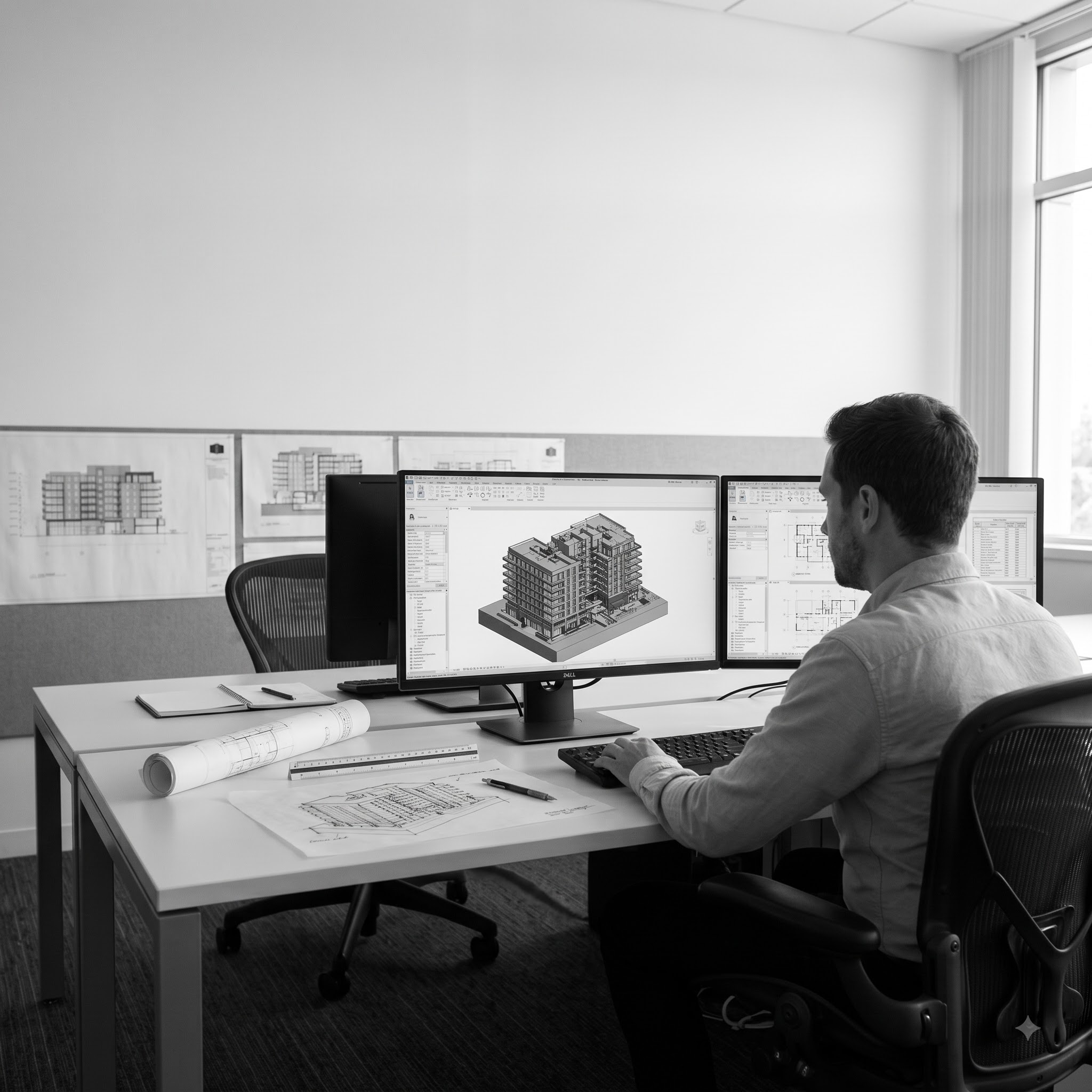
The project team established Revit as the central documentation platform with all architectural elements modeled in three-dimensional building information model. Floor plans, sections, elevations, and schedules all generated directly from the model rather than drafted separately.
This fundamental shift from drawing production to model development represented significant workflow change. Team members needed to think three-dimensionally about building assembly rather than two-dimensionally about drawing composition. Initial adjustment proved challenging but yielded substantial efficiency benefits once team members internalized the model-based approach.
The workflow emphasized model accuracy and completeness. If the model accurately represented design intent, drawings generated from it would be accurate. This contrasted with traditional workflow where each drawing required individual attention to accuracy. Model-based approach concentrated accuracy effort in the model itself with drawings following automatically.
Template and Standards Development
Successful BIM implementation required comprehensive Revit template and standards development before significant documentation work began. The team invested approximately 160 hours developing project-specific template, families, and standards.
The template included standardized view templates controlling graphic appearance, comprehensive annotation and dimension styles consistent with firm standards, sheet templates matching firm's established documentation format, and pre-built schedules for common building elements.
Custom Revit families were developed for project-specific building elements including apartment entry doors and hardware, kitchen and bathroom fixtures and fittings, balustrade and railing systems, and typical facade assemblies and window configurations.
This upfront investment felt substantial when beginning the project but proved essential to downstream efficiency. Standardized templates and families enabled consistency and speed once documentation production accelerated.
Team Training and Adoption
The five-person team had varying Revit experience. The project architect had moderate Revit familiarity from previous exposure. Two mid-level architects had basic Revit knowledge but limited production experience. Two junior team members were Revit novices requiring fundamental training.
The firm invested in targeted training addressing team needs. External Revit training provided foundational knowledge for team members new to the platform. Internal mentoring from more experienced users helped team members apply skills to actual project work. Regular team coordination meetings shared modeling approaches and problem-solving strategies.
Initial productivity dropped during the learning curve period. Team members worked more slowly in unfamiliar software while developing proficiency. The firm anticipated this temporary slowdown and factored it into project planning. Over 6-8 weeks, team productivity recovered and began exceeding traditional workflow speeds as proficiency developed.
Quality Control Integration
BIM implementation included structured quality control processes ensuring model accuracy and documentation quality. Weekly model coordination sessions reviewed model development identifying issues early. Automated clash detection between architectural and structural models caught coordination problems. Drawing review cycles verified that model-generated drawings met documentation standards.
Quality control benefited from BIM's inherent coordination. When floor plan changed, sections and elevations automatically updated maintaining consistency. This automatic coordination eliminated common documentation errors where one drawing was updated but related drawings weren't, creating contradictory information.
Measured Results: The 40% Efficiency Gain
Systematic tracking throughout the project enabled quantitative assessment of BIM efficiency compared to traditional workflow.
Documentation Time Comparison
The complete documentation from design development through construction documentation required approximately 1,680-1,920 hours of team effort. Comparing this to the firm's historical benchmark of 2,800-3,200 hours for comparable projects using traditional workflow revealed 35-45% time reduction with 40% representing the mid-point estimate.
This 40% efficiency gain translated directly to project economics. At average blended team rate of $95 per hour, 1,120 hours saved (40% of 2,800 hours) represented approximately $106,000 in preserved fee that traditional workflow would have consumed. For a project with architectural fee around $450,000, this efficiency gain protected substantial margin that would otherwise have eroded through documentation time overruns.
Breaking down efficiency gains by documentation phase revealed where BIM delivered greatest impact:
Design development phase: 35% time reduction through rapid design iteration using parametric modeling and automated drawing generation.
Construction documentation phase: 42% time reduction through model-based documentation, automated schedules, and coordinated multi-view generation.
Revision and coordination phase: 48% time reduction through automatic update propagation and clash detection identifying issues early.
Coordination Efficiency Improvements
Multi-disciplinary coordination improved substantially through BIM implementation. The project generated 25% fewer RFIs during construction compared to the firm's historical average for similar projects. This reduction directly resulted from better pre-construction coordination using 3D clash detection and coordination meetings reviewing federated models.
Services coordination particularly benefited from three-dimensional model review. Ceiling space coordination that traditionally required extensive 2D overlay checking and often missed conflicts became visual and obvious in 3D federated models. Structural-architectural coordination occurred continuously through the documentation process rather than in discrete coordination review sessions.
Early clash detection prevented issues from reaching construction. Problems identified and resolved during documentation cost minimal effort compared to resolving during construction requiring rework and delay.
Revision and Rework Reduction
Documentation revision time decreased approximately 35% compared to traditional workflow. When design changes occurred during documentation development, model-based approach meant changes propagated automatically across all affected views and drawings.
For example, when apartment bathroom layouts required modification affecting 40 apartments, the model update automatically updated floor plans, reflected in sections and elevations, updated door and fixture schedules, and maintained coordination with structure and services. Traditional workflow would require manually updating each affected drawing separately, consuming substantially more time and creating error risk.
Error correction similarly benefited from automatic coordination. When errors were identified during review, model correction automatically corrected all affected drawings rather than requiring individual drawing fixes.
Quality Metrics
Objective quality measurement proved challenging but several indicators suggested improved documentation quality:
Construction RFIs requesting clarification or additional information decreased 25% compared to firm averages, suggesting clearer, more complete documentation.
Coordination conflicts discovered during construction decreased approximately 60%, indicating better pre-construction coordination.
Drawing consistency errors (plans not matching sections, schedules not matching drawings) essentially eliminated through model-based coordination.
Authority approval process proceeded smoothly without significant documentation deficiency issues requiring resubmission.
These quality improvements delivered value beyond time savings. Better documentation quality reduced construction issues, improved builder relationships, and enhanced client satisfaction.
What Drove the Efficiency Gains
Understanding specific factors creating efficiency helps principals identify which elements apply to their practices and workflows.
Automated Documentation from Model
The single largest efficiency driver was automatic drawing generation from the central model. Floor plans, reflected ceiling plans, sections, elevations, details, and schedules all generated automatically from model geometry and data rather than being drafted individually.
This automation meant design changes updated all affected drawings automatically. A window type change updated floor plans showing the window, elevations displaying the window, window schedules listing specifications, and details showing installation. Traditional workflow required manually updating each drawing separately.
The efficiency multiplier increased with project complexity. More repetitive elements and more interconnected drawings amplified automatic coordination benefits. Multi-residential projects with repetitive apartment layouts particularly benefited from this automation.
Design Coordination Improvements
Three-dimensional modeling revealed design coordination issues during documentation development that traditional 2D approach missed until construction. Ceiling height conflicts with structure and services, clearance issues around equipment and access, spatial conflicts between building elements, and dimensional coordination across different building areas all became visible in the model.
Identifying these issues during documentation rather than construction meant resolution consumed design time (relatively inexpensive) rather than construction time (expensive). Early issue identification prevented costly on-site discoveries and rework.
Reduced Rework from Early Clash Detection
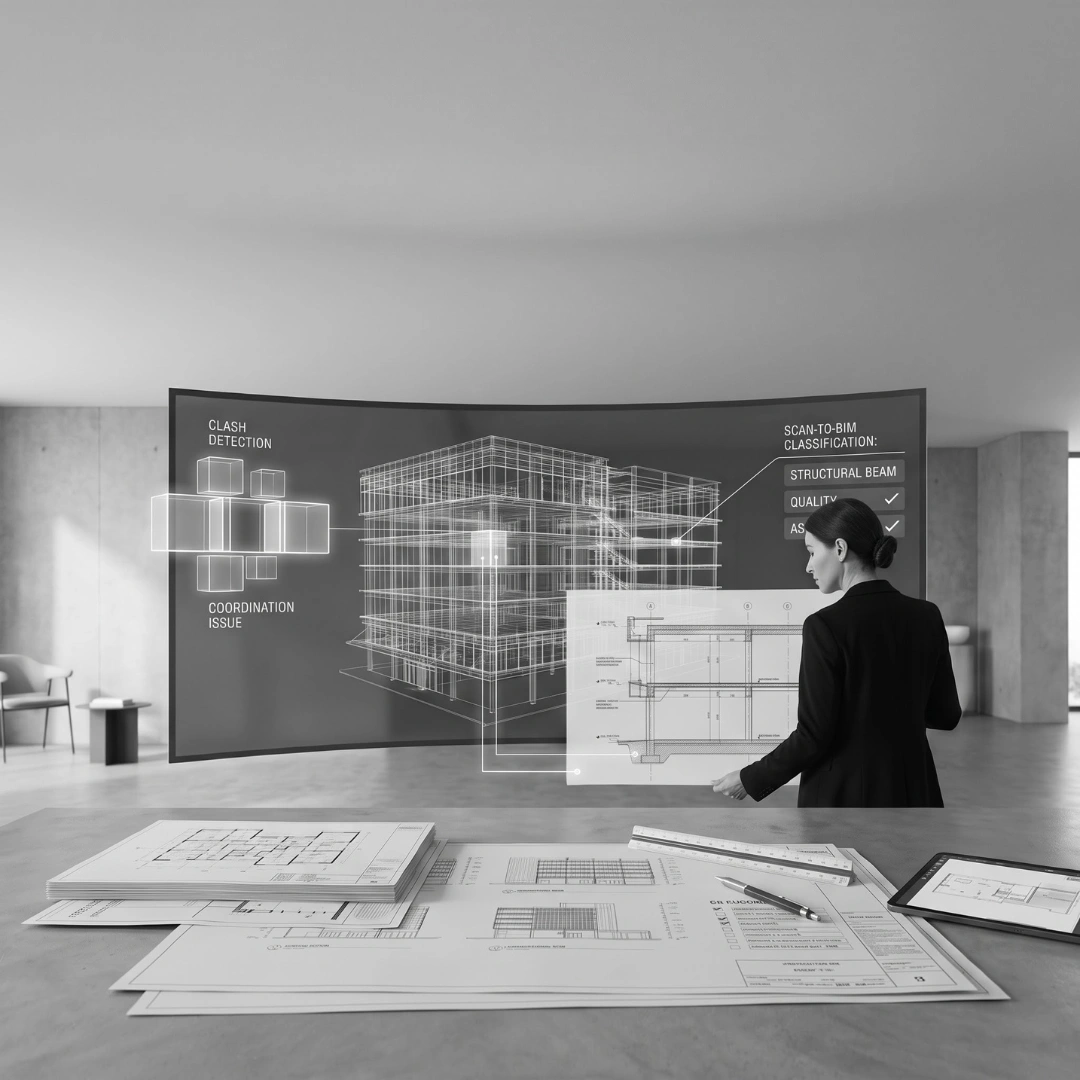
Federated model coordination between architectural, structural, and services models identified geometric conflicts before construction. Automated clash detection systematically checked millions of potential intersections identifying conflicts human review would miss.
The project coordination identified approximately 180 clashes requiring resolution. Without BIM coordination, most would have been discovered during construction requiring costly rework. Resolving during documentation consumed modest coordination time preventing substantial construction issues.
Standardized Details and Families
Revit families for typical building elements enabled rapid documentation of repetitive conditions. Custom families developed for apartment doors, kitchen layouts, bathroom configurations, and facade assemblies allowed quick placement and automatic schedule generation.
Initial family development required upfront time investment but paid efficiency dividends throughout documentation. Each apartment bathroom used standardized family components enabling rapid modeling and automatic fixture schedules. Traditional workflow required drafting each bathroom individually and manually creating schedules.
Multi-Disciplinary Coordination
BIM enabled continuous coordination throughout documentation rather than periodic coordination reviews. The team could overlay structural and services models at any time checking coordination. Issues identified immediately rather than waiting for scheduled coordination meetings.
This continuous coordination created efficiency through early issue identification. Problems discovered and resolved quickly while documentation was in progress consumed minimal effort compared to discovering issues during formal coordination review requiring extensive rework.
Implementation Challenges and Solutions
Honest assessment requires acknowledging challenges alongside benefits. BIM implementation wasn't seamless; several obstacles required active management.
Learning Curve and Initial Slowdown
Team members unfamiliar with Revit worked slowly initially while developing proficiency. The first 6-8 weeks showed productivity below traditional workflow as team members learned software and modeling approaches.
The firm managed this challenge by anticipating the learning period in project planning, providing targeted training addressing specific knowledge gaps, pairing experienced users with novices for mentoring, and accepting temporary productivity reduction as investment in future efficiency.
By week 10, team productivity matched traditional workflow. By week 16, productivity exceeded traditional workflow and efficiency gains accelerated through project completion.
Team Resistance and Change Management
Some team members initially resisted BIM adoption preferring familiar AutoCAD workflows. This resistance manifested as skepticism about efficiency claims, preference for "quick" AutoCAD sketches over model development, and reluctance to invest time learning new approaches.
Project leadership addressed resistance through clear communication about strategic rationale, demonstration of efficiency benefits as they materialized, recognition and support for team members struggling with transition, and firm but consistent expectation that BIM adoption was non-negotiable direction.
As efficiency benefits became tangible, resistance diminished. Team members experiencing productivity gains became advocates rather than skeptics.
Technical Issues Encountered
Several technical challenges emerged during implementation. Model performance degraded as model size increased requiring workstation upgrades for some team members. File sharing and collaboration required cloud-based workflows team members needed to learn. Revit crashes and software bugs occasionally disrupted work requiring problem-solving and workarounds.
These technical issues proved manageable but required IT support and problem-solving time. The firm addressed technical challenges through hardware upgrades ensuring adequate computing power, cloud collaboration platform implementation, regular model auditing and cleanup maintaining performance, and external Revit technical support for complex issues.
How Challenges Were Overcome
Success required persistent management through challenges rather than expecting seamless transition. Critical success factors included leadership commitment maintaining BIM direction despite obstacles, adequate training and support resources, realistic timeline expectations accounting for learning curve, team communication addressing concerns and sharing successes, and willingness to problem-solve technical and workflow issues.
Firms expecting effortless BIM adoption will face disappointment. Those preparing for transition challenges and managing them systematically can achieve substantial efficiency gains demonstrated in this project.
Lessons Learned and Applicability
Reflection on project experience reveals insights applicable to other practices considering BIM adoption or optimization.
What We Would Do Differently
With hindsight, several adjustments would improve implementation efficiency. Earlier and more comprehensive template development would reduce downstream rework as standards evolved. More intensive upfront training before project commencement would accelerate team proficiency. Earlier hardware upgrades would prevent performance bottlenecks that emerged mid-project. More structured knowledge sharing sessions would accelerate team learning from each other's discoveries.
These refinements wouldn't fundamentally change outcomes but would smooth the implementation process and potentially achieve efficiency gains earlier in the project timeline.
Critical Success Factors
Several factors proved essential to achieving documented efficiency gains:
Leadership commitment to BIM direction despite inevitable challenges. Adequate upfront investment in templates, standards, and training. Team proficiency development through training and practice. Realistic timeline expectations accounting for learning curve. Quality control processes ensuring model accuracy. Hardware and software infrastructure supporting BIM workflows. Continuous coordination with consultants using federated models.
Practices implementing BIM without these success factors risk disappointing results. Comprehensive implementation addressing all factors creates conditions for efficiency gains.
Which Practices Can Replicate Results
The efficiency gains demonstrated are achievable for practices with:
Willingness to invest in proper BIM implementation (not superficial adoption). Commitment to team training and skill development. Projects with sufficient scope justifying BIM investment (typically projects over $2M construction value). Leadership patience to work through learning curve period. Technical infrastructure supporting BIM workflows.
Small practices doing primarily residential alterations under $500K may struggle to justify BIM investment. Mid-sized practices doing multi-residential, commercial, or mixed-use projects are ideal candidates for BIM efficiency gains.
What's Required for Similar Gains
Achieving 30-45% efficiency gains requires systematic implementation not just software purchase. Essential requirements include comprehensive Revit template and standards aligned with documentation requirements, custom family library for typical project elements, team training achieving functional Revit proficiency, quality control processes maintaining model accuracy, coordination workflows with consultants and contractors, adequate hardware infrastructure, and realistic timeline expectations during transition.
Practices implementing BIM comprehensively following proven workflows can reasonably expect efficiency gains in this range. Those implementing partially or superficially should expect more modest improvements.
ROI Analysis: Beyond Time Savings
Quantifying BIM return on investment provides business case validation for principals evaluating implementation.
Cost-Benefit Calculation
BIM implementation costs for this project included:
Revit licenses (5 users): $12,000 annually Hardware upgrades (2 workstations): $8,000 one-time Template and standards development: 160 hours × $95/hour = $15,200 Training (external and internal): $8,500 Cloud collaboration platform: $3,600 annually Total first-year BIM cost: $47,300
Benefits realized:
Documentation time savings: 1,120 hours × $95/hour = $106,400 Reduced construction RFIs: Estimated $15,000 in avoided issues Improved documentation quality: Estimated $8,000 in prevented errors Total quantified benefits: $129,400
First-year ROI: 174% ($129,400 benefit / $47,300 cost)
Subsequent projects benefit from established templates, trained team, and infrastructure without repeating one-time costs, improving ongoing ROI substantially.
Margin Protection
For fixed-fee projects, documentation efficiency directly protects margin. This project's 1,120-hour savings at $95/hour represented $106,400 in preserved fee. On $450,000 architectural fee, this efficiency protected approximately 24% of gross fee that would otherwise have consumed through documentation time overruns.
Given typical practice overhead and profit targets, this efficiency gain likely represented difference between healthy project profitability and break-even or loss outcome.
Client Value Delivery
Beyond internal economics, BIM enabled better client value delivery through higher quality documentation reducing construction issues, faster response to client changes and requests, better visualization supporting client decision-making, and comprehensive coordination preventing costly construction delays.
These client-facing benefits enhance reputation and competitive positioning for future work opportunities.
Competitive Advantage
Documentation efficiency creates competitive advantage through ability to deliver higher quality within fixed fee budgets, faster turnaround for time-sensitive projects, competitive fee proposals while maintaining profitability, and capacity to take additional projects with same team resources.
In competitive Sydney architecture market, efficiency advantages translate directly to business development success and practice growth.
FAQ: BIM Efficiency Case Study
Are 40% efficiency gains typical or exceptional for BIM implementation?
Efficiency gains of 30-45% are achievable for practices implementing BIM comprehensively with proper training, templates, and workflows on appropriate project types. These gains represent realistic outcomes, not exceptional cases. However, achieving these results requires systematic implementation, not superficial BIM adoption. Practices implementing BIM partially or without adequate training, standards, and workflows typically achieve 10-20% efficiency gains. The 40% result demonstrated here required comprehensive implementation with upfront template development, team training, and quality control processes. Projects particularly suited to BIM (multi-residential, commercial, institutional with repetitive elements and complex coordination) show higher gains than simple residential alterations or renovations.
How long before efficiency gains offset the learning curve slowdown?
This project experienced 6-8 week learning curve period where productivity lagged traditional workflow while team developed Revit proficiency. Productivity matched traditional workflow by week 10 and exceeded it significantly by week 16. For 12-month documentation timeline, approximately 20-25% of project duration involved learning curve impacts with remaining 75-80% benefiting from efficiency gains. The overall 40% efficiency gain represents net result after accounting for learning curve slowdown. Practices should expect similar patterns: temporary productivity reduction during skill development followed by accelerating efficiency gains as proficiency develops. Subsequent projects benefit immediately without repeating learning curve.
Can smaller architecture firms achieve similar results?
Firm size matters less than project type and implementation approach. This project involved 5-person team at mid-sized practice, but small 2-3 person practices have achieved comparable efficiency gains on appropriate projects. Critical factors are project scope justifying BIM investment (typically $2M+ construction value), commitment to comprehensive implementation not superficial adoption, adequate training ensuring team proficiency, and patience working through learning curve period. Very small practices doing primarily residential alterations under $500K may struggle to justify BIM investment. Those doing multi-residential, commercial, or institutional work can achieve similar efficiency gains regardless of firm size.
What if our consultants don't use BIM?
Architectural BIM implementation delivers value even when consultants use traditional workflows. The documented efficiency gains resulted primarily from architectural workflow improvements: automated drawing generation, design coordination, and revision efficiency. Consultant BIM adoption amplifies benefits through federated model coordination but isn't prerequisite for architectural efficiency gains. Many practices implement BIM architecturally while coordinating with traditional 2D structural and services documentation. As BIM becomes standard practice, consultant BIM adoption increases, enabling additional coordination benefits. Start with architectural BIM implementation regardless of consultant capabilities.
How do we justify BIM investment to firm leadership?
Build business case using quantifiable benefits demonstrated in this case study. For typical multi-residential or commercial project, document expected documentation time for traditional workflow (use historical project data), estimate realistic BIM time savings (30-40% for comprehensive implementation, 15-25% for moderate implementation), calculate preserved fee value from time savings, compare against BIM implementation costs (licenses, training, templates), and demonstrate ROI typically 150-300% first year, higher subsequently. Emphasize that BIM investment isn't just software cost but strategic practice capability development protecting margins and enabling competitive positioning. For partners concerned about implementation risk, propose pilot project approach testing BIM on single suitable project before full practice-wide adoption.
Achieving Similar Results
This Sydney multi-residential project demonstrates that substantial BIM efficiency gains are achievable through systematic implementation, not just vendor marketing claims. The 40% documentation time reduction resulted from comprehensive BIM workflow adoption including model-based documentation, automated drawing generation, early clash detection, standardized families and templates, and continuous multi-disciplinary coordination.
Critical success factors enabling these results included leadership commitment maintaining direction despite challenges, adequate upfront investment in templates and training, team proficiency development through structured learning, realistic timeline expectations during transition, quality control processes ensuring accuracy, and appropriate technical infrastructure.
The efficiency gains protected substantial project margin on fixed-fee work while improving documentation quality and coordination. Benefits extended beyond time savings to include margin protection, client value delivery, and competitive advantage in practice business development.
For principals evaluating BIM investment or optimization, this case study provides evidence that meaningful efficiency improvements are realistic on appropriate projects with proper implementation. The gains aren't automatic; they require systematic adoption, adequate training, and patience through learning curves. Practices willing to invest properly in BIM implementation can reasonably expect documentation efficiency improvements in the 30-45% range transforming project economics and practice capacity.
Obelisk has delivered BIM documentation for 100+ multi-residential and commercial projects across Australian architecture practices, applying systematic workflows that reduce documentation time by 30-45% while maintaining quality and coordination. Our experience developing efficient BIM processes, comprehensive Revit templates and standards, and quality control frameworks helps practices achieve measurable productivity gains.
Improve Your Documentation Efficiency
Obelisk provides BIM documentation services for Australian architecture firms, applying proven workflows that reduce documentation time while improving coordination quality.
✓ Systematic BIM Workflows: Proven processes delivering 30-45% documentation efficiency gains
✓ Multi-Residential Expertise: Extensive experience with residential and mixed-use projects
✓ Australian Standards: Documentation compliant with local authority requirements
✓ Quality Focused: Comprehensive coordination preventing construction issues
✓ Revit Excellence: Advanced Revit capabilities and custom template development
✓ Practice Partnership: Supporting architecture firms across project documentation phases
We help Australian practices improve documentation productivity and project profitability.
Discuss Your BIM Requirements: team@obelisk.au
Systematic BIM documentation delivering measurable efficiency gains.
TABLE OF CONTENTS

















.png)
.png)
.webp)