


Industrial Facility Documentation: BIM Requirements for Warehouses and Manufacturing

An industrial warehouse appears straightforward compared to complex commercial towers or healthcare facilities. Until you document one. A 25,000-square-meter distribution center requires portal frame structural systems spanning 30+ meters with precise deflection limits, floor slabs carrying 25-50 kN/m² forklift and racking loads, 40+ truck loading docks with precise dimensional coordination, high-bay lighting integrated with 12-meter clear heights, ESFR sprinkler systems protecting high-rack storage, heavy electrical infrastructure serving automated material handling, site civil works managing stormwater from massive impervious areas, and truck circulation accommodating B-double semi-trailers and container movements. All delivered on compressed fast-track schedules where construction starts before documentation completes.
For Principal Architects pursuing industrial work, documentation demands differ fundamentally from residential or commercial projects. Structural systems dominate design with portal frames, moment frames, or hybrid structures requiring sophisticated coordination. Floor slabs aren't afterthoughts but critical elements carrying forklift traffic and rack loads. Clear heights determine building value more than architectural expression. Operational efficiency drives spatial planning with material flow, logistics, and production workflows taking precedence over aesthetic considerations.
This comprehensive guide provides Australian architects with detailed framework for industrial facility BIM documentation covering warehouses through manufacturing plants and specialized facilities. You'll learn facility-type specific requirements, structural system options and coordination, operational workflow documentation, industrial building compliance, BIM organization for large-scale facilities, fast-track delivery methodologies, and proven approaches from 90+ industrial projects delivered across logistics, manufacturing, and industrial processing sectors since 2010.
Industrial Facility Types and Documentation Scope
Industrial sector encompasses diverse facility types with distinct operational requirements and documentation complexity.
Warehouses and Distribution Centers
Warehouses store and distribute goods ranging from small parcel e-commerce fulfillment centers to large distribution hubs serving retail networks. Typical 20,000-square-meter distribution center contains high-bay storage areas with 10-12 meter clear heights accommodating rack storage, picking and packing zones for order fulfillment, shipping and receiving with 30-50 loading docks, cross-dock areas for transfer operations where applicable, staff amenities and offices, and battery charging areas for electric forklifts and material handling equipment.
Documentation scope addresses structural systems enabling long clear spans (portal frames typically 25-35 meter spacing), floor slab design for heavy point loads (rack uprights, forklift traffic), loading dock dimensional requirements (1.2-1.4m dock height, truck well depth, leveler pits), sprinkler design for high-rack storage (often ESFR early suppression fast response systems), site circulation for B-double semi-trailers (19.7m trailer length plus prime mover), and future expansion provisions enabling facility growth.
Warehouse BIM models typically contain 15,000-40,000 elements across large single-story footprints with focus on structural coordination, services integration in ceiling zones, and site civil coordination.
Manufacturing Facilities
Manufacturing facilities transform raw materials into finished products ranging from light assembly through heavy industrial processing. Typical manufacturing plant contains production areas with equipment layouts and process flows, raw material and finished goods storage, quality control and testing laboratories, maintenance workshops and spare parts storage, shipping and receiving docks, and staff facilities including offices, amenities, and sometimes training rooms.
Documentation addresses production equipment loads and clearances (some equipment weighing 50-200+ tonnes), floor loading for manufacturing processes (can exceed 100 kN/m² in heavy industry), overhead crane systems (monorail, bridge cranes with runway beams), process services (compressed air, process cooling, exhaust systems, specialized gases), vibration-sensitive equipment requiring isolated foundations, and hazardous materials storage meeting dangerous goods requirements.
Manufacturing BIM complexity varies dramatically by industry from light assembly (similar to warehouse complexity) through heavy manufacturing involving extensive structural coordination for equipment, cranes, and process systems.
Cold Storage and Controlled Environment Facilities
Cold storage facilities maintain temperature-controlled environments for perishable goods. Facilities range from -25°C frozen storage through +2°C to +4°C chilled environments and ambient temperature dry storage. Documentation requirements include insulated building envelope (typically 150-200mm insulation thickness), refrigeration plant and equipment coordination, vapor barriers and moisture management, loading docks with rapid-roll doors minimizing temperature loss, racking systems in sub-zero environments, and condensation management in transition zones.
Cold storage introduces specialized requirements including thermal bridging prevention at structural connections, floor insulation and heating (preventing ground freezing), refrigeration equipment coordination (condenser locations, piping runs, defrost systems), and operational considerations for working in sub-zero environments.
Industrial Processing Plants
Process industries including food and beverage, chemical, pharmaceutical, and mineral processing have facility-specific requirements. Common elements include process equipment installation (tanks, reactors, separators, dryers), material handling systems (conveyors, pneumatic transfer, pumping), utility infrastructure (steam, compressed air, process water, chilled water, nitrogen), wastewater treatment, and environmental controls (dust collection, fume extraction, emission control).
Documentation complexity increases substantially with process integration, equipment coordination, piping and services distribution, and regulatory compliance for food safety, pharmaceutical manufacture, or hazardous chemical processing.
Data Centers
Data centers house IT infrastructure requiring specialized design. Critical requirements include high floor loading for equipment (8-12 kN/m² typical for raised floors plus equipment), redundant power infrastructure (N+1 or 2N configurations), precision cooling systems maintaining 18-27°C with tight humidity control, physical security (multiple access control levels), fire suppression (typically gaseous systems protecting equipment), and structured cabling infrastructure.
Data center documentation addresses electrical infrastructure (often multiple megawatts), cooling system coordination, raised floor coordination with structure and services, security zoning and access control, and often Tier III or IV certification requirements.
Logistics and Intermodal Facilities
Intermodal facilities transfer freight between transport modes (rail to truck, ship to truck). Requirements include container handling equipment (reach stackers, straddle carriers, gantry cranes), rail siding infrastructure, extensive truck maneuvering areas, container storage yards, and dangerous goods segregation where applicable.
Documentation coordinates heavy pavements for container handling, rail infrastructure integration, specialized equipment foundations and clearances, and site planning for efficient container movement.
Structural Systems and Loading Requirements
Industrial facility value depends fundamentally on structural performance enabling operational efficiency.
Portal Frame vs. Moment Frame Structures
Portal frames dominate Australian warehouse and light industrial construction. Portal frame benefits include economical long spans (25-35 meters column spacing typical), rapid construction with prefabricated components, flexible internal layouts without intermediate columns, and proven performance in industrial applications.
Portal frame design considerations include clear height requirements (10-15 meters typical for warehouse, higher for specialized facilities), eaves height allowing for services (sprinklers, lighting, HVAC) below structure, bay spacing balancing economy with functionality, and roof slope (typically 5-10 degrees for drainage and aesthetics).
BIM coordination for portal frames addresses rafter depths affecting clear heights and services coordination, haunch geometry at beam-column connections, bracing systems (roof and side wall bracing), and expansion joint locations for long buildings.
Moment frame structures suit applications requiring irregular column grids, future modifications or expansions, integration with multi-story offices, and architectural expression through exposed structure.
Heavy Floor Loading and Slab Design
Industrial floor slabs carry substantially heavier loads than commercial buildings. Loading categories include forklift traffic: 15-25 kN/m² for counterbalance forklifts up to 5 tonnes capacity, racking loads: 25-50 kN/m² for selective pallet racking, higher for drive-in/push-back systems, manufacturing equipment: 50-100+ kN/m² depending on equipment type and concentration, and point loads from rack uprights, equipment feet, and vehicle wheels.
Slab specifications typically include 150-200mm thickness for standard warehouse (higher for heavy industrial), steel fiber reinforcement (30-40 kg/m³) or conventional mesh, joints every 6 meters maximum (saw-cut or formed construction joints), hardened surface treatment for forklift traffic, and flatness requirements (FM2/FL50 or better for high-bay racking).
BIM coordination demonstrates slab thickness compatibility with loading dock heights, floor levels coordinating with drainage requirements, joint locations avoiding rack upright positions where possible, and surface levels enabling drainage to collection points.
Mezzanine and Racking Integration
Mezzanines expand usable floor area in high-bay facilities. Design coordination includes structural support (columns to slab or suspended from roof structure), access (stairs, lifts, goods lifts at specified locations), fire separation (often required between mezzanine and ground floor), sprinkler coverage (above and below mezzanine floor), and services distribution to mezzanine level.
Racking systems often integrate with building structure through seismic bracing tied to building frame, fire suppression specifically designed for rack configuration, and aisle widths coordinating with forklift specifications and building column locations.
Clear Height and Column Spacing
Clear height represents critical industrial facility value driver. Each additional meter of clear height enables additional rack storage levels. Standard clear heights include 8-10 meters for older warehouses, 10-12 meters for modern distribution centers, 12-15 meters for high-bay automated facilities, and 15+ meters for specialized bulk storage.
Clear height documentation in BIM requires accurate modeling of lowest structural elements, sprinkler pipe drops and head clearances, lighting fixture depths, HVAC ductwork (if applicable), and other services ensuring specified operational clear height.
Column spacing balances structural economy with operational flexibility. Standard warehouse column grids include 25 x 30 meters (typical portal frame), 30 x 30 meters, and 35 x 30 meters for larger facilities. Manufacturing may require column-free zones for production equipment layouts with irregular grids elsewhere.
Crane and Material Handling Loads
Overhead cranes introduce substantial structural loads requiring early coordination. Crane specifications include capacity (1 tonne to 100+ tonnes), span (building width), runway length, and duty classification (light, medium, heavy).
Structural coordination addresses crane runway beams (sized for crane wheel loads plus impact), runway beam support (columns designed for vertical and horizontal crane loads), clearances (hook height, approach dimensions), power supply (festoon system, cable reels), and maintenance access.
Monorail systems for lighter loads (250kg to 2 tonnes) coordinate with roof structure, requiring connection points, clearances, and electrical supply.
Industrial Building Classification and Compliance
Industrial buildings navigate specific BCA provisions and compliance requirements.
BCA Class 7 and 8 Provisions
Industrial facilities classify as Class 7 (storage) or Class 8 (laboratory, production) under BCA. Classification affects fire safety requirements, egress provisions, and services standards.
Class 7a (carpark) applies to parking areas. Class 7b (storage of goods or produce) applies to warehouses and distribution centers. Class 8 (laboratory, production) applies to manufacturing facilities.
Key compliance provisions include fire resistance levels (FRL) varying by building size and fire compartment area, smoke hazard management (often challenging in high-bay spaces with large open areas), egress travel distances (often generous in industrial compared to commercial), emergency lighting and exit signage, and fire services (hydrants, hose reels, sprinklers, smoke detection).
Fire Safety in Industrial Buildings
Industrial fire safety reflects storage/production risks and occupancy characteristics. Sprinkler systems dominate protection strategies with standard response sprinklers for low-hazard storage, ESFR (Early Suppression Fast Response) for high-piled storage, and specialized systems for flammable liquids, aerosols, or other hazardous materials.
Smoke and heat venting in high-bay facilities uses roof-mounted smoke vents (typically 2.5% of floor area), mechanical smoke exhaust, or combined systems. Large open areas affect smoke spread calculations and detection system design.
Documentation demonstrates fire compartment sizing compliance, construction achieving required FRL, sprinkler system hydraulic calculations and coverage, smoke detection and alarm systems, emergency egress complying with travel distances, and essential safety measure schedules.
Essential Safety Measures
Industrial buildings have extensive ESM including fire services (sprinklers, hydrants, hose reels), mechanical ventilation and smoke control, emergency lighting and exit signs, portable fire extinguishers, emergency warning systems, and exit doors and exit signs.
BIM models support ESM documentation through fire services coordination, emergency lighting layouts, exit signage locations, and equipment schedules.
Dangerous Goods Storage Requirements
Facilities storing dangerous goods comply with AS 1940 (flammable liquids), AS 2507 (LPG storage), relevant state dangerous goods legislation, and site-specific environmental protection license conditions.
Documentation addresses segregation distances from site boundaries, ignition source separation, bunding and spill containment, ventilation for flammable vapor management, and fire protection systems compatible with hazards.
Environmental Compliance
Industrial facilities trigger environmental assessment and ongoing compliance including stormwater quality management (sediment basins, gross pollutant traps, swales), trade waste and wastewater treatment, air emissions control (odor, particulates, VOCs), noise management (particularly 24-hour operations), and contaminated land assessment and remediation where applicable.
Environmental Protection Licenses specify operational requirements affecting facility design including stack heights for emission discharge, acoustic barriers or building treatments, wastewater pre-treatment facilities, and dangerous goods storage provisions.
Operational Requirements and Workflow
Industrial facility success depends on operational efficiency documented through spatial planning and workflow analysis.
Material Flow and Logistics
Efficient material flow minimizes handling costs and time. Warehouse flow patterns include through-flow (receiving one end, shipping opposite end), U-flow (receiving and shipping from same end with storage between), and cross-dock (direct transfer from receiving to shipping with minimal storage).
Documentation demonstrates receiving dock quantity and configuration, storage area organization (bulk storage, pallet racking, small parts picking), picking area layouts and access, packing and dispatch areas, and shipping dock quantity and configuration.
Manufacturing flow patterns follow product transformation from raw materials through processing to finished goods. Flow analysis identifies process sequence, material transfer points, work-in-progress storage, quality control locations, and waste/byproduct handling.
Production Line Layouts
Manufacturing production lines require precise equipment layouts coordinated with structure and services. Documentation includes equipment footprints and clearances, maintenance access requirements, material input and output locations, utility connections (power, compressed air, water, drain), and operator workstation ergonomics.
Production flexibility increasingly requires reconfigurable layouts documented through modular service distribution (floor trenches, overhead service booms), flexible partitioning systems, and moveable equipment provisions.
Truck Access and Loading Docks
Truck access represents critical industrial facility element. Design requirements include approach roads accommodating B-double semi-trailers (minimum 12m internal radius for 90-degree turns), truck parking and maneuvering areas, loading dock configuration (typically 1.2-1.4m height, 3.5-4.0m centers), dock levelers (mechanical or hydraulic), dock shelters or seals, and truck well depth enabling semi-trailer bed access.
Site planning ensures adequate truck queuing (particularly at peak shipping times), separation of truck and car traffic, and future expansion capability.
Staff Amenities and Offices
Industrial facilities provide staff amenities meeting industrial award requirements and operational needs including change rooms and lockers (often segregated male/female), amenities (toilets, showers meeting AS 1428 accessible provisions), meal rooms and kitchen facilities, first aid rooms, and offices for management and administration.
Office integration options include integrated offices (within warehouse building envelope, often mezzanine level), attached offices (connected to warehouse but separate structure), or detached offices (separate building on site).
Future Flexibility and Expansion
Industrial facilities plan for growth and change through site planning enabling building expansion, structural systems enabling future extensions (frame spacing accommodating end bay addition), services infrastructure oversized for future loads, and operational layouts adaptable to changing requirements.
BIM documentation shows expansion scenarios testing feasibility and identifying infrastructure requirements.
BIM Requirements for Industrial Projects
Industrial facility BIM addresses large footprints, structural complexity, and fast-track delivery requirements.
Model Organization for Large Footprints
Industrial facilities ranging 10,000-100,000+ square meters require disciplined model organization. Spatial subdivision strategies include grid-based zoning (dividing building into 50m x 50m or 100m x 100m zones), functional zoning (production, storage, shipping/receiving, offices as separate models), structural bay grouping (portal frame bays as logical divisions), and phased construction packages.
Large model management techniques include linked models reducing individual file sizes, view filtering and worksets enabling team members to work efficiently, and cloud collaboration managing model synchronization across teams.
Structural Coordination Complexity
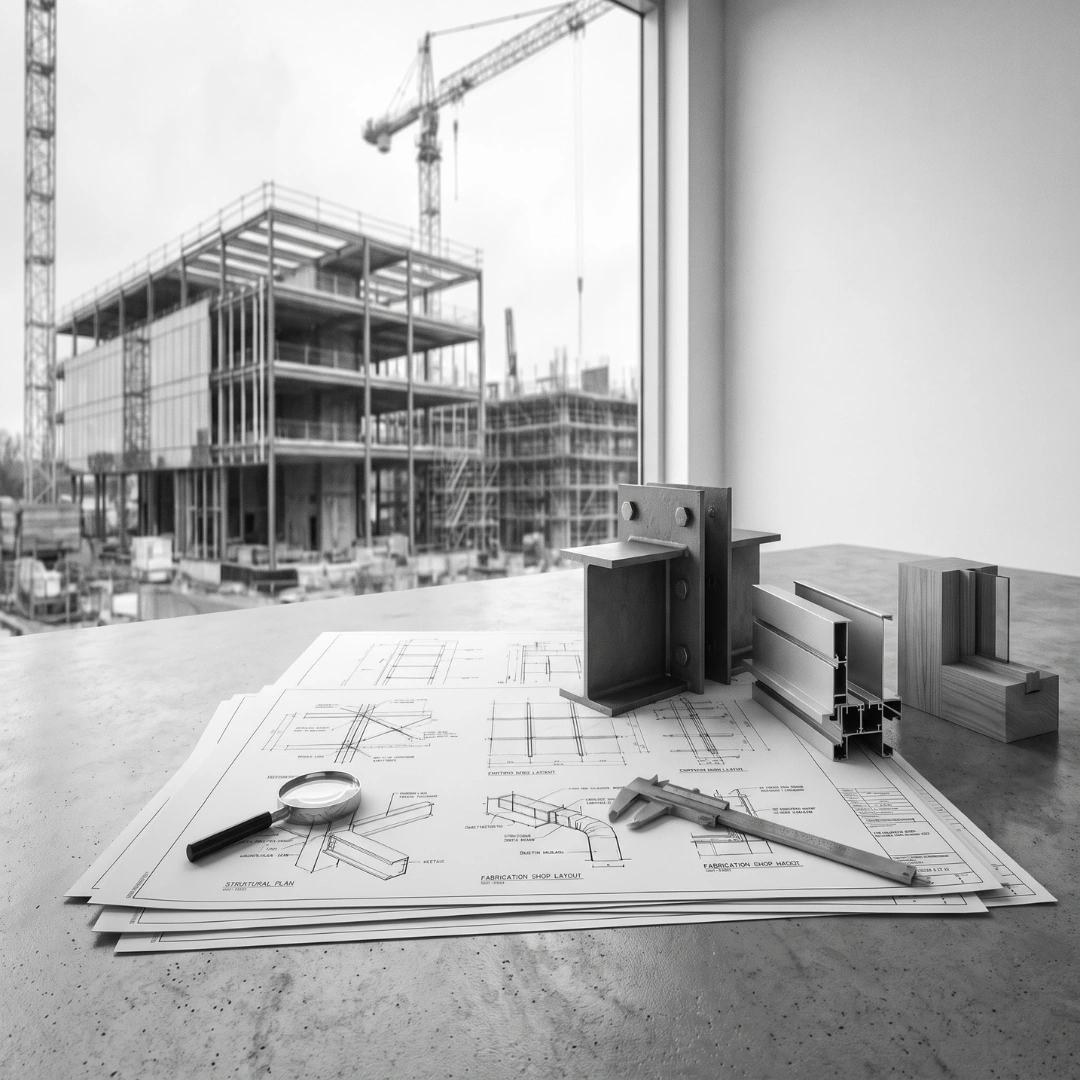
Industrial structural systems require extensive coordination beyond typical commercial projects. Portal frame coordination addresses rafter depths and haunch geometry affecting services routing, bracing systems coordinating with wall cladding and openings, crane runway beams coordinating with building frame, and expansion joints managing building length and thermal movement.
Heavy floor loading requires foundation coordination including ground bearing capacity verification, pile locations and capacities, suspended slabs where applicable, and footing coordination with underground services.
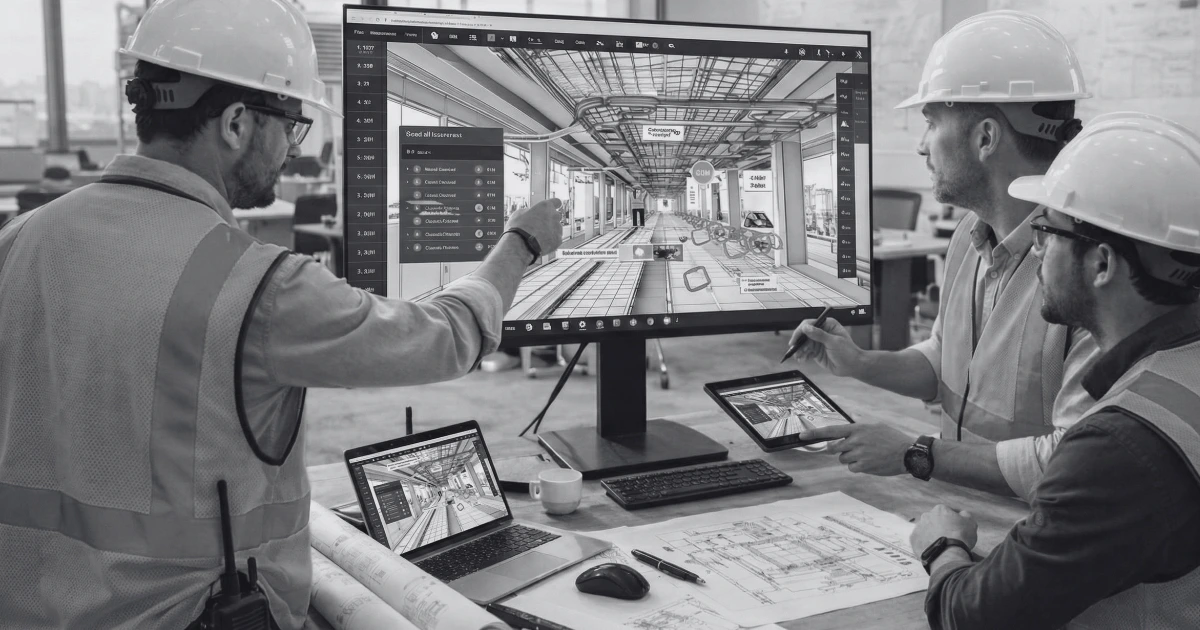
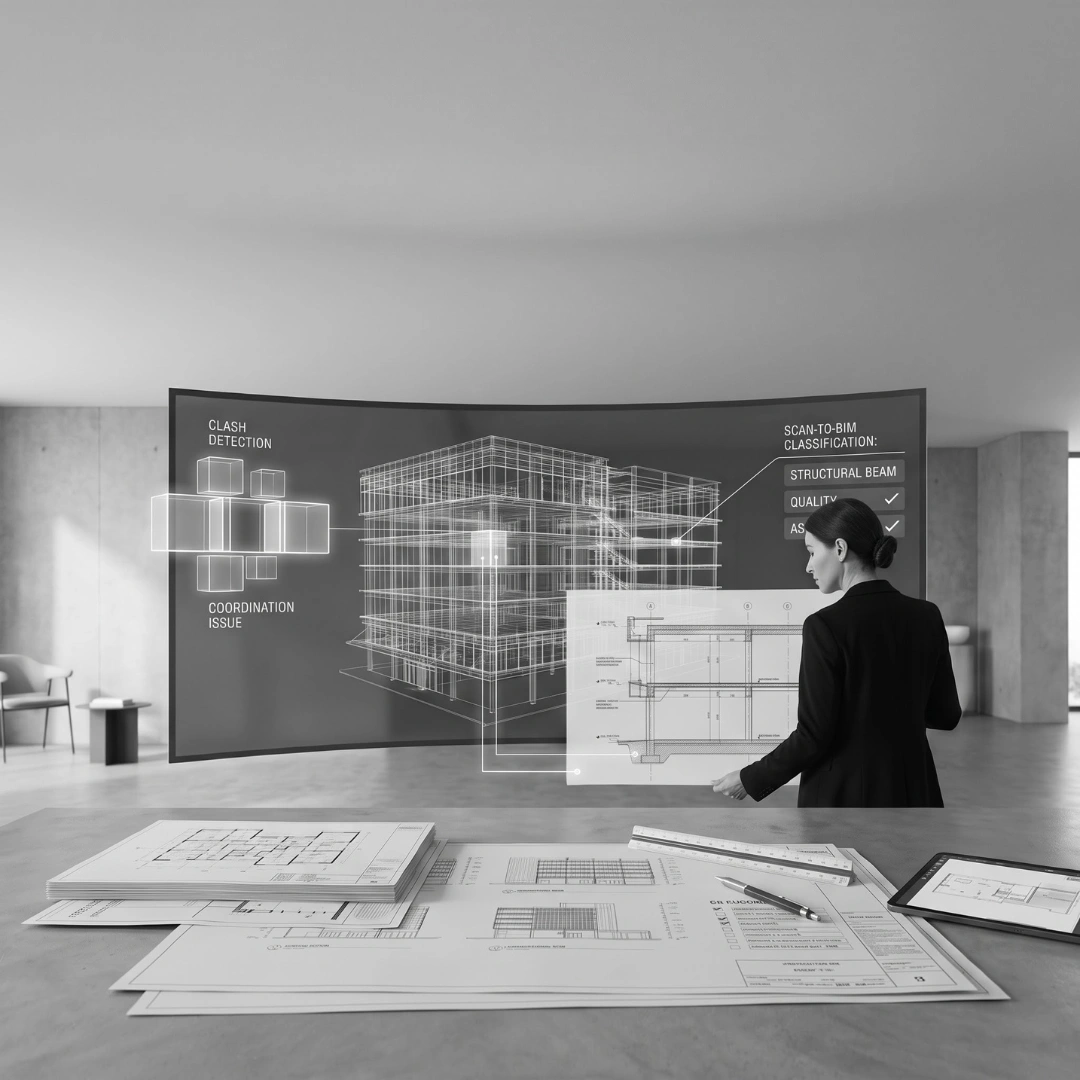
BIM clash detection identifies conflicts between structural elements and MEP systems, particularly in ceiling zones where structure, sprinkler mains, electrical cable trays, and lighting compete for limited space.
Services Integration
Industrial services, while often simpler than commercial buildings per square meter, involve large-scale coordination. Electrical infrastructure includes main switchboard and distribution board locations and sizing, cable tray routing through large open spaces, lighting layouts for high-bay spaces (LED high-bay luminaires typical), and power distribution to production equipment or material handling systems.
Fire protection dominates ceiling coordination with sprinkler mains (often 150-200mm diameter), branch lines and sprinkler heads, fire separation walls extending through roof, and smoke detection in high-bay spaces.
HVAC varies from minimal (ambient storage) through comfort cooling (offices and amenities) to specialized systems (cold storage, clean rooms, process cooling).
Fast-Track Delivery Methodologies
Industrial projects frequently use fast-track delivery where construction starts before documentation completes. BIM enables fast-track through staged documentation packages (foundations, structure, envelope, services released sequentially), early contractor involvement (design-build or ECI contracts), coordinated models supporting prefabrication, and progressive design releases coordinated with construction sequences.
Fast-track documentation requires disciplined model management freezing completed areas, managing design changes affecting construction sequencing, coordinating consultant design progress, and clear package documentation defining scope boundaries.
As-Built Documentation for Operations
Industrial facilities increasingly require comprehensive as-built BIM supporting operations and maintenance. Deliverables include as-built models at LOD 400 showing constructed conditions, equipment registers with specifications and warranties, operations and maintenance documentation, energy management and utility monitoring baseline data, and future modification scenarios.
Services and Infrastructure Coordination
Industrial services support operational requirements ranging from basic warehouse through sophisticated manufacturing.
Heavy Electrical Loads
Industrial electrical infrastructure serves building services and production equipment. Warehouse electrical loads include lighting (typically 5-8 W/m² for LED high-bay), material handling equipment (battery charging, automated systems), HVAC and refrigeration where applicable, and office and amenity areas.
Manufacturing electrical loads vary dramatically from light assembly (similar to warehouse) through heavy manufacturing (multiple megawatts for production equipment, process heating, motors, and drives).
Electrical coordination addresses main switchboard capacity and location, generator backup for critical operations, distribution board locations serving defined zones, cable tray routing and capacity, equipment connections and isolation, and electrical room sizing and access.
Industrial HVAC and Process Cooling
Warehouse HVAC is often minimal with natural ventilation through high-level louvres, destratification fans preventing heat accumulation at roof level, spot cooling for office/amenity areas, and evaporative cooling where climate suitable.
Manufacturing HVAC ranges from comfort conditioning through process-critical environmental control including production area temperature and humidity control, clean rooms and controlled environments, process cooling for equipment and products, and exhaust systems for fumes, dust, or heat.
Coordination addresses plant room sizing and locations, ductwork routing in ceiling zones, outdoor equipment locations (chillers, cooling towers, condensers), and process integration where manufacturing processes require cooling.
Compressed Air and Process Gases
Manufacturing facilities often require compressed air for pneumatic tools and equipment, process control valves and instruments, and product processing or packaging.
Compressed air systems require compressor room design and ventilation, distribution piping through facility, moisture removal (dryers, separators), and pressure regulation for different applications.
Specialized gases (nitrogen, carbon dioxide, oxygen, argon) for manufacturing require bulk storage or generation, distribution piping, and safety provisions for gas detection and emergency shutdown.
Fire Protection Systems
Industrial fire protection is dominated by sprinkler systems. Warehouse sprinkler design addresses storage height and configuration (rack storage, pile storage, floor storage), commodity hazard classification, ESFR vs. control-mode density/area sprinklers, and water supply capacity (often requiring substantial storage tanks and fire pumps).
Sprinkler coordination in BIM demonstrates adequate coverage (sprinkler spacing complying with AS 2118), clearances from obstructions (minimum 1 meter clearance from storage typically), and hydraulic design capacity through pipe sizing and pump specifications.
Site Infrastructure and Utilities
Large industrial sites require substantial external infrastructure including site electrical supply (often dedicated transformer/substation), water supply (potable, fire water, process water), sewer connection (sometimes requiring pre-treatment), gas supply where applicable, telecommunications and data, stormwater management (detention basins, quality treatment), and site lighting and security.
Site services coordination uses civil BIM models linking with building models ensuring coordinated utilities, managing underground service conflicts, and demonstrating authority requirements compliance.
Site Planning and External Works
Industrial site planning addresses truck circulation, parking, landscaping, and future expansion.
Truck Circulation and Parking
Efficient truck access is fundamental to industrial facility value. Design requirements include approach roads minimum 7 meters wide (preferably 10+ meters enabling passing), internal circulation roads 10-12 meters wide, turning paths accommodating B-doubles (19.7m trailer plus prime mover), truck parking for drivers (often 20-30 spaces for large distribution centers), and queuing capacity during peak shipping periods.
Site layout separates truck and car circulation, provides adequate maneuvering at loading docks (often 45-60 meter truck apron depth), and enables future expansion without compromising circulation.
Container Storage and Handling
Facilities handling shipping containers require container storage areas (paved, often 40+ TEU capacity), container handling equipment clearances (reach stackers, forklifts, or gantry cranes), and container loading zones separate from general truck docks.
Stormwater and Drainage
Large impervious industrial sites generate substantial stormwater requiring comprehensive drainage design including on-site detention (OSD) controlling discharge rates to match pre-development, water quality treatment (gross pollutant traps, bioretention systems, swales), discharge to stormwater system or watercourse, and pollution prevention (bunding, spill containment, trade waste separation).
BIM coordination demonstrates site grading, drainage collection systems, OSD basin sizing and locations, and treatment system integration.
Landscaping and Screening
Industrial sites require landscaping for amenity, screening, and environmental performance including perimeter landscaping screening operations from neighboring properties, carpark shade trees, water sensitive urban design (WSUD) elements, and indigenous planting where applicable.
Council requirements often specify landscape coverage percentages (10-20% typical) and screening heights.
Future Expansion Provisions
Industrial facilities plan for expansion through site master planning showing staged development scenarios, infrastructure sizing accommodating ultimate development, and building structural systems enabling extensions.
Fast-Track Delivery and Design-Build Collaboration
Industrial construction timelines demand specialized documentation approaches.
Staged Documentation Release
Fast-track projects release documentation progressively enabling early construction start. Typical package sequence includes civil and site works enabling site establishment and construction access, foundations and ground slab starting structural works, structural frame proceeding independently, building envelope enabling weather protection, and services completing installation.
Staged release requires disciplined model coordination ensuring package interfaces are clear, managing design changes affecting completed packages, and maintaining document version control.
Contractor Coordination
Design-build and ECI (Early Contractor Involvement) contracts require collaborative documentation development with contractor input on constructability and value engineering, prefabrication opportunities maximizing off-site fabrication, procurement sequencing optimizing lead times, and staging plans coordinating construction sequencing.
BIM collaboration enables contractor model review and markup, coordination meetings using federated models, and construction sequencing simulation.
Value Engineering Integration
Industrial projects emphasize cost efficiency driving value engineering focused on structural optimization (frame spacing, member sizing), building envelope economy (wall and roof systems), services rationalization (lighting, sprinkler design optimization), and site works efficiency (bulk earthworks, drainage design).
BIM supports value engineering through rapid design iteration, cost estimation from model quantities, and performance verification for alternative systems.
Early Works Packages
Maximizing construction parallelization requires early works packages before full documentation completion. Early packages include site establishment and enabling works, bulk earthworks and site preparation, foundation installation, and sometimes structural frame procurement.
Documentation defines package scope precisely preventing rework when later packages release.
Procurement Strategies
Industrial procurement often separates design and construction scopes with architect documentation enabling competitive construction tender, design-build contracts integrating design and construction, and construction management approaches where owner directly engages multiple trade contractors.
BIM documentation adapts to procurement strategy providing performance specifications for design-build, prescriptive documentation for construct-only contracts, or coordinated consultant models for construction management.
FAQ: Industrial Facility BIM Documentation
What makes industrial facility documentation different from commercial projects?
Industrial documentation emphasizes structural performance over architectural expression, with portal frames, heavy floor loading, and crane systems dominating design. Operational efficiency drives spatial planning through material flow analysis, logistics optimization, and production workflows rather than aesthetic considerations. Documentation addresses truck access requiring B-double semi-trailer circulation, loading docks with precise dimensional requirements, high-bay storage requiring 10-15 meter clear heights, and heavy floor loading (25-100 kN/m²) versus standard commercial (5-8 kN/m²). Fast-track delivery compresses schedules requiring staged documentation release, early contractor involvement, and progressive design while construction proceeds. Compliance focuses on Class 7/8 BCA provisions, industrial fire protection (ESFR sprinklers), dangerous goods storage, and environmental requirements. Industrial clients prioritize functionality, cost efficiency, and schedule over architectural statement creating different project priorities than commercial work.
How do we coordinate portal frame structures in BIM?
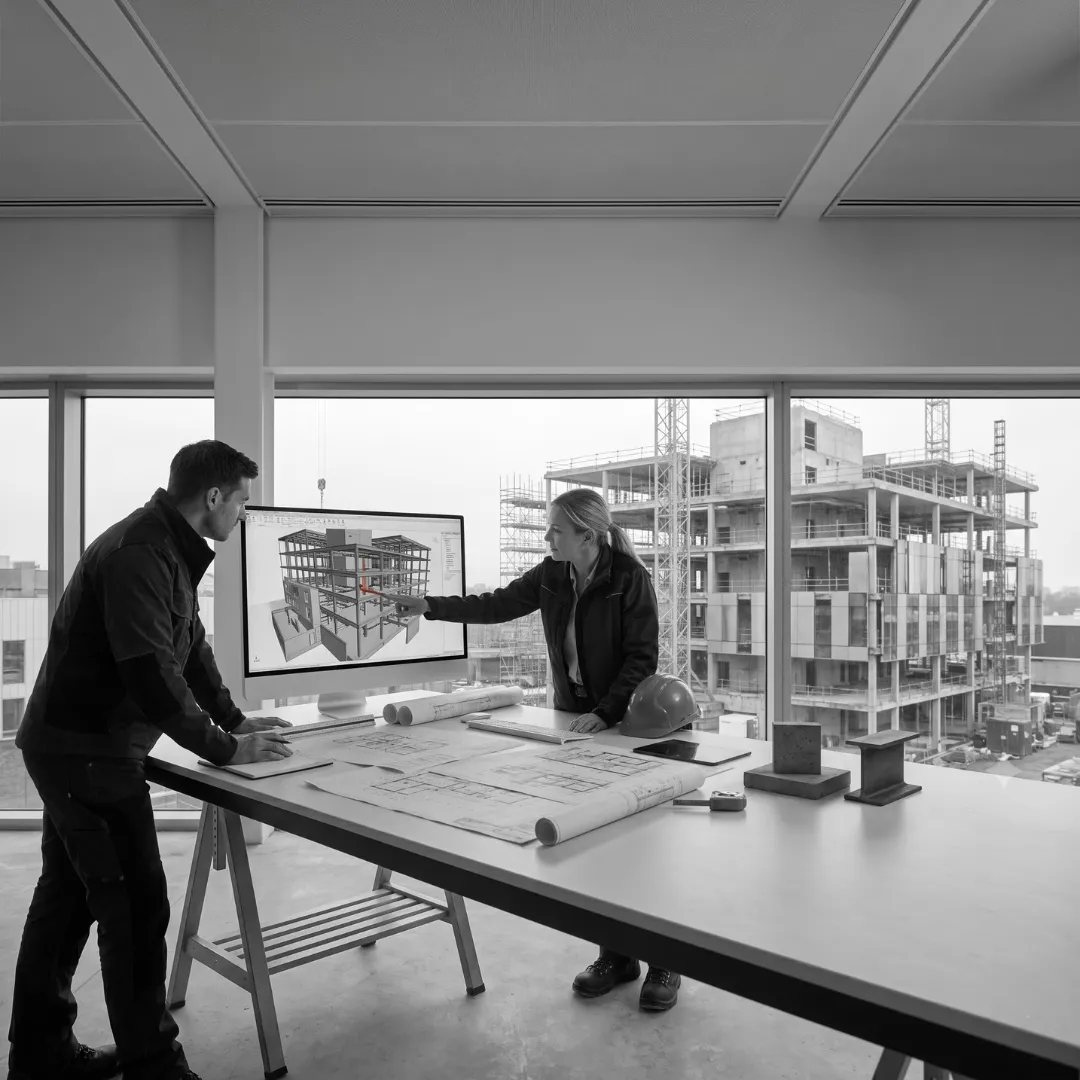
Portal frame coordination requires detailed structural modeling addressing rafter depths affecting clear heights and services clearances, haunch geometry at beam-column connections (often 2-3 meters long, 1.5+ meters deep), bracing systems (roof plane bracing, side wall bracing coordinating with wall openings), eaves height and roof slope affecting rainwater drainage, and expansion joints for long buildings managing thermal movement. Services coordination in ceiling zones is critical as sprinkler mains, electrical cable trays, and lighting compete for space below rafters. Model portal frames accurately including all structural elements, coordinate with structural engineer's model identifying conflicts, run clash detection between structure and services focusing on ceiling zone, verify clear heights accounting for lowest structural elements and services, and document critical dimensions (eaves height, clear height, rafter spacing) in schedules extracted from BIM. Early structural coordination (design development phase) prevents costly rework when services don't fit in ceiling zones.
What BIM deliverables do industrial clients typically require?
Industrial client BIM requirements vary from minimal (traditional 2D documentation only) through sophisticated as-built BIM for facilities management. Construction documentation typically requires coordinated architectural, structural, and services models at LOD 350-400, clash-free coordination demonstrating resolved conflicts, documentation drawings extracted from coordinated models, and equipment schedules with specifications. Progressive industrial clients request as-built BIM at LOD 400 showing constructed conditions, equipment registers with maintenance data, operational documentation (material flow, logistics layouts), energy management baselines, and future expansion scenarios. Design-build projects may require performance specifications rather than prescriptive documentation enabling contractor design development. Clarify deliverable requirements during project inception as requirements vary substantially between clients and project delivery methods. Industrial developers building speculative facilities often require minimal documentation while owner-occupiers operating facilities long-term increasingly demand comprehensive BIM.
How do we handle fast-track industrial projects where construction starts before documentation completes?
Fast-track success requires disciplined staged documentation approach. Identify early packages releasing first (typically civil/site works, foundations, structural frame) and prioritize these in documentation schedule. Establish clear package scope boundaries preventing interface issues between packages. Coordinate design progression across consultants ensuring foundation documentation reflects final structural loads even if superstructure detail incomplete. Use BIM model management freezing completed zones preventing changes affecting construction. Maintain regular coordination meetings with contractor reviewing design progression and construction sequencing. Document design assumptions for incomplete areas preventing contractor uncertainty. Manage design changes rigorously assessing impact on completed or under-construction work. Accept higher documentation risk than traditional delivery but mitigate through coordination and communication. Fast-track requires experienced team comfortable with progressive design release and contractor collaboration rather than complete documentation before construction commences.
What are typical structural loading requirements for different industrial facility types?
Industrial floor loading varies dramatically by use. Standard warehouses with forklift traffic and selective pallet racking require 25-35 kN/m² uniformly distributed load (UDL) plus point loads from rack uprights. High-density storage using drive-in racking or automated systems may require 50+ kN/m² UDL. Light manufacturing and assembly typically requires 30-50 kN/m² depending on equipment. Heavy manufacturing can exceed 100 kN/m² with concentrated equipment loads requiring special foundations. Cold storage facilities often require 30-40 kN/m² accounting for racking in sub-zero environments. Overhead crane systems add 10-50 kN/m (or more) to runway beams depending on crane capacity. Floor specifications typically include 150-200mm thick slabs for standard warehouse, steel fiber reinforcement (30-40 kg/m³), and hardened surface for forklift traffic. Confirm loading requirements early in design through client equipment specifications and forklift/material handling requirements as underestimated loading leads to expensive structural upgrades or operational restrictions.
Delivering Efficient Industrial Facilities
Industrial facility documentation demands sector-specific technical expertise spanning structural systems, operational requirements, and fast-track delivery methodologies. From warehouses and distribution centers through manufacturing plants and specialized industrial facilities, industrial buildings emphasize functional performance, structural efficiency, and operational optimization over architectural expression creating distinct documentation priorities and technical challenges.
BIM documentation supports industrial complexity through large-scale model coordination managing 20,000+ square meter facilities, structural system integration coordinating portal frames, heavy floor loading, and crane systems, services coordination in high-bay spaces, operational workflow documentation demonstrating material flow and logistics efficiency, and fast-track delivery enabling staged documentation release and progressive construction.
Success in industrial sector requires understanding facility type variations from basic storage through sophisticated manufacturing, structural system options (portal frames, moment frames, hybrid systems), operational requirements (material flow, production layouts, truck access), industrial building compliance (BCA Class 7/8, fire protection, dangerous goods), and fast-track delivery methodologies enabling compressed construction schedules.
Obelisk has delivered BIM documentation for 90+ industrial facilities across Australia spanning warehouses and distribution centers, manufacturing and processing plants, cold storage and controlled environments, logistics and intermodal facilities, and specialized industrial buildings. Our industrial sector expertise encompasses structural coordination for portal frames, heavy loading, and crane systems, operational workflow documentation and material flow optimization, fast-track delivery with staged documentation packages, Australian industrial standards compliance (BCA, AS 3600, AS 4100), and large-scale BIM coordination for facilities ranging 10,000-100,000+ square meters.
Industrial Facility BIM Documentation Services
Obelisk provides specialist BIM documentation for warehouses, manufacturing facilities, and industrial buildings across Australia.
✓ Industrial Sector Expertise: 90+ warehouses, manufacturing plants, distribution centers
✓ Structural Coordination: Portal frames, heavy floor loading, crane systems
✓ Operational Understanding: Material flow, logistics, production workflows
✓ Fast-Track Capability: Staged documentation, early packages, design-build collaboration
✓ Large-Scale Projects: Facilities 10,000-100,000+ square meters
✓ As-Built Documentation: Operations support and facilities management integration
We help Australian architects deliver efficient industrial facilities meeting operational requirements.
Discuss Your Industrial Project: team@obelisk.au
Specialist industrial facility BIM documentation for Australian warehouses and manufacturing.
TABLE OF CONTENTS




















.png)
.png)
.webp)