

Construction Document Coordination Issues: How to Eliminate RFIs and Delays

Your project manager spends another morning processing RFIs. Structural steel clashes with ductwork, requiring redesign. Architectural door locations conflict with structural columns. Ceiling heights don't accommodate services as documented. Each issue stops work, delays schedules, and generates another round of correspondence, clarifications, and revisions.
Most construction projects generate 150-300 RFIs. Each RFI takes 3-7 days to resolve and costs $800-1,500 in management time, delay costs, and potential rework. For a $10M project, poor coordination can add $180,000-450,000 in avoidable costs while extending schedules by weeks or months.
These coordination issues shouldn't reach construction. Systematic pre-construction coordination using 3D clash detection and multi-discipline review catches 90-95% of conflicts before site mobilization. Australian builders implementing comprehensive coordination processes typically reduce RFIs by 60-80% while improving construction efficiency and reducing schedule risk.
This guide explains why coordination issues occur, how they impact projects financially, and provides a proven 5-stage framework for eliminating coordination problems before construction begins.
The Hidden Cost of Poor Document Coordination
Poor coordination incurs costs that extend far beyond the individual RFI resolution time. Understanding the full financial impact justifies investment in systematic coordination processes.
Direct RFI Management Costs
Each RFI consumes resources across multiple organizations:
Builder project management time: 2-4 hours per RFI documenting the issue, distributing to consultants, tracking response, reviewing solution, and communicating resolution. At typical PM rates, this represents $200-400 per RFI in management costs alone.
Design team response time: 3-6 hours per RFI for consultant review, coordination, solution development, and documentation updates. Design fees typically include an RFI allowance, but excessive RFIs can incur additional consultant charges or damage relationships.
Review and approval time: 1-3 hours for certifier or authority review if RFI affects compliance. Building certifiers charge for additional review time beyond the normal inspection scope.
For a project generating 200 RFIs, direct management costs alone total $40,000-80,000. This doesn't include delay costs or rework expenses.
Construction Delay Costs
RFIs stopping work create delay costs similar to documentation emergencies, but accumulate over many smaller incidents:
Trade delay costs: When MEP trades discover coordination conflicts, work stops for that area while waiting for resolution. Even if other work continues, affected trades lose productivity. Typical trade delay costs range from $1,000 to $3,000 per day for small crews.
Schedule compression: Making up lost time from coordination delays requires overtime, additional crews, or expedited delivery at premium pricing. Schedule compression typically adds 15-30% to affected trade costs.
Domino effect: Coordination issues affecting critical path activities delay subsequent trades. The delay multiplies as each following activity shifts later in the schedule.
Through analysis of 600+ Australian construction projects, we've found that coordination issues typically extend project schedules by 8-15% compared to well-coordinated projects. For a 52-week construction program, that's 4-8 weeks of extended preliminaries, site costs, and delayed project completion.
Rework and Material Waste
Poor coordination creates rework when elements are installed based on incorrect documentation, and then must be removed or modified:
Material waste: Incorrectly fabricated elements that don't fit require replacement. Structural steel was cut to the wrong dimensions. Ductwork is fabricated for locations where beams interfere. Precast panels with penetrations in the wrong locations.
Installation rework: Elements installed in documented locations that conflict with other trades require removal and reinstallation. This doubles installation labor costs and potentially damages materials, making them unsuitable for reuse.
The Australian construction industry estimates that 5-8% of construction costs represent avoidable rework. For a $10M project, that's $500,000-800,000. Poor coordination contributes significantly to this rework burden.
Relationship and Reputation Damage
Beyond direct financial costs, poor coordination damages business relationships:
Subcontractor relationships suffer when coordination issues they didn't cause delay their work. Subcontractors become reluctant to work with builders whose projects consistently have coordination problems.
Client satisfaction drops when coordination issues delay completion or require visible compromises. Clients judge builder competence partly on how smoothly construction proceeds.
Repeat business opportunities diminish when projects are remembered for coordination chaos rather than efficient delivery.
These intangible costs have real financial impacts through reduced tendering success rates and lost repeat business opportunities.
Cumulative Project Impact
Consider a typical $10M commercial construction project:
RFI management costs (200 RFIs × $1,000 average): $200,000. Schedule delays (10% extension on 52 weeks): $180,000 in extended preliminaries. Rework and waste (3% of construction value): $300,000. Total coordination-related cost impact: $680,000
This represents 6.8% of project value lost to coordination issues that systematic pre-construction coordination would largely prevent.
Most Common Construction Coordination Issues
Understanding common coordination failure patterns helps identify where systematic coordination processes add most value.
Architectural-Structural Conflicts
Architectural and structural documentation conflicts create some of the most disruptive coordination issues because they typically affect critical path activities and multiple subsequent trades.
Beam and Ceiling Height Conflicts:
Structural beams deeper than architectural ceiling heights are accommodated. Architects design ceiling systems without accounting for structural depth. The result is inadequate ceiling cavity depth for services or ceiling heights below the minimum requirements.
These conflicts often aren't discovered until service coordination begins or ceiling installation attempts reveal insufficient space. Resolution requires either structural redesign (expensive and time-consuming) or architectural ceiling height adjustments affecting room proportions and potentially code compliance.
Column Location Conflicts:
Structural columns are placed where architectural layouts require open space. Common scenarios include columns interfering with door swings, columns in the middle of corridors, columns conflicting with furniture layouts, or columns obstructing sight lines in public spaces.
These issues force a choice between structural modifications (expensive) or architectural layout changes (affecting functionality and possibly requiring client approval).
Opening and Penetration Conflicts:
Architectural door and window locations are conflicting with structural load paths. Penetrations for stairs, lifts, or services located where structural elements must occur. Floor penetrations are not coordinated with the beam layouts below.
Resolution requires either relocating openings (architectural redesign) or modifying the structural system (engineering redesign and potentially authority resubmission).
MEP Coordination Failures
Mechanical, electrical, and plumbing services create the highest volume of coordination conflicts because services occupy three-dimensional space throughout buildings and must coordinate with all other disciplines.
Ductwork and Structure Clashes:
Air conditioning ductwork routes are documented where structural beams occur. This is the single most common coordination conflict in commercial construction. Large ductwork requires substantial vertical space. Beams occupy the same horizontal planes where ductwork must run.
Without 3D coordination, ductwork routes shown on MEP drawings are in locations where structural drawings show beams. The conflict isn't apparent when reviewing 2D drawings separately, but becomes obvious when overlaid in 3D space or when trades attempt installation.
Services Clash With Services:
Different services are conflicting with each other. Ductwork clashing with electrical trays. Plumbing pipes are interfering with conduits. Sprinkler pipework is conflicting with the air conditioning equipment.
These conflicts occur because each consultant designs their system somewhat independently, making assumptions about available space without comprehensive multidisciplinary coordination.
Services Exceeding Available Ceiling Space:
Total services depth exceeding available ceiling cavity. Each discipline designs its system fitting within the documented ceiling cavity. However, when all services combine in the actual three-dimensional space, total depth exceeds the available cavity.
This forces compromises: reducing duct sizes (affecting system performance), lowering ceilings (reducing floor-to-ceiling heights), raising floor levels (affecting overall building height), or complex services routing (increasing cost and maintenance difficulty).
Access and Maintenance Conflicts:
Services are located where access for maintenance is impossible or inadequate. Equipment is positioned where removal for replacement can't occur. Isolation valves are located behind permanent construction. Control panels are obstructed by other elements.
These issues create ongoing maintenance problems and expensive access modifications during building operation.
Multi-Discipline Clashes
Beyond two-discipline conflicts, some coordination issues involve three or more disciplines simultaneously:
Structural columns, architectural walls, and services all converge at the same location. Fire-rated walls require continuous construction, conflicting with duct penetrations and structural beams. Accessibility requirements affecting ramp gradients, door locations, structural platforms, and service equipment placement. Acoustic separation requirements are conflicting with services penetrations through rated walls
These multi-disciplinary issues are particularly difficult to resolve because solutions affecting one discipline impact others, requiring iterative coordination across multiple consultants.
Missing or Conflicting Information
Beyond geometric clashes, coordination issues arise from incomplete or contradictory information:
Specification-Drawing Conflicts:
Specifications describing different systems, equipment, or materials than those shown on drawings. When specifications and drawings conflict, contractors must seek clarification before proceeding, generating RFIs even without geometric coordination issues.
Drawing-Drawing Conflicts:
Different drawings showing the same element differently. Plans showing one configuration while sections show another. Details contradict the general arrangement drawings. Revision levels are not synchronized across drawing sets.
Incomplete Information:
Critical information is missing from the documentation. Connection details not provided. Material specifications are incomplete. Performance requirements are undefined. Builders can't price accurately or construct confidently without complete information.
Assumption Gaps:
Each discipline makes different assumptions about shared elements. Architects assuming structural system provides certain capacities. Engineers assume architectural finishes provide certain access. Services designers assume available space for their systems.
When assumptions don't align across disciplines, problems emerge during construction.
Why Traditional Coordination Processes Fail
Understanding why traditional coordination approaches prove insufficient helps explain the value of systematic 3D coordination.
2D Coordination Limitations
Traditional coordination involves consultants reviewing each other's 2D drawings. Architectural plans overlaid with structural plans. Services layouts compared to architectural sections. This approach has inherent limitations:
Human visual processing struggles to interpret three-dimensional reality from multiple two-dimensional representations. A beam shown in plan at one elevation and ductwork shown in section at another elevation may or may not clash in three-dimensional space depending on exact vertical positions and horizontal alignments.
Even experienced professionals miss conflicts reviewing 2D documentation because the conflicts aren't visually obvious until translated into three-dimensional reality.
Incomplete Review Coverage
Traditional coordination review typically samples rather than comprehensively examines all intersections:
Consultants review drawings, checking obvious conflict areas, but can't feasibly examine every geometric intersection across thousands of elements. Time and budget constraints limit review depth. Some conflicts simply aren't noticed during document review.
This sampling approach catches major obvious conflicts but misses many smaller issues that still disrupt construction when discovered on site.
Reactive Rather Than Proactive
Traditional processes often address coordination issues reactively as they're discovered rather than proactively seeking them systematically:
Coordination happens when someone notices a conflict rather than through systematic checking of all potential conflicts. Many issues aren't identified until installation attempts reveal them.
By that point, resolution options are limited, and costs are high because construction has reached that area.
Responsibility Gaps
Coordination responsibility often falls between disciplines:
Design contracts typically make each consultant responsible for their discipline, with "reasonable coordination" with others. However, "reasonable" isn't precisely defined. When conflicts occur, determining responsibility becomes contentious.
Without clear coordination, responsibility, and systematic processes, issues slip through gaps between consultants' scopes.
Time Pressure Compromises
Construction schedules create pressure to complete documentation quickly:
Comprehensive coordination takes time. When documentation is rushed to meet construction start dates, coordination quality suffers. Consultants prioritize completing their own designs over thorough multi-disciplinary coordination.
The time saved in documentation gets lost many times over in construction coordination delays.
The Systematic Coordination Solution: 5-Stage Framework
Systematic coordination using 3D modeling and clash detection addresses traditional coordination limitations through comprehensive, technology-enabled processes.
Stage 1: Early Design Coordination
Coordination begins during design development, not after documentation completion.
Preliminary 3D Models:
Create preliminary 3D models of all major systems during design development. These models aren't fully detailed but show major elements: structural grids and primary framing, architectural massing and major spaces, MEP systems routing and major equipment, and coordination zones for services.
Early 3D visualization reveals major coordination issues when design changes are still relatively easy and inexpensive.
Coordination Principles:
Establish coordination principles guiding detailed design:
Services coordination zones: Define ceiling cavity depths, service corridors, and riser locations adequate for all disciplines. Each discipline is designed within allocated zones.
Priority hierarchies: Establish which systems take precedence when conflicts occur. Typically: structure first (most difficult to change), then primary building services, then secondary systems, then finishes.
Access and maintenance requirements: Define clearances and access requirements upfront, ensuring all disciplines accommodate them.
These principles prevent conflicts rather than discovering them after they occur.
Multi-Discipline Workshops:
Conduct coordination workshops bringing all consultants together to review preliminary models and resolve emerging issues collaboratively:
Face-to-face coordination is more effective than sequential document review. Issues are discussed and resolved in real-time rather than through extended RFI processes.
Workshops at 25%, 50%, and 75% design completion catch and resolve issues progressively rather than discovering everything at documentation completion.
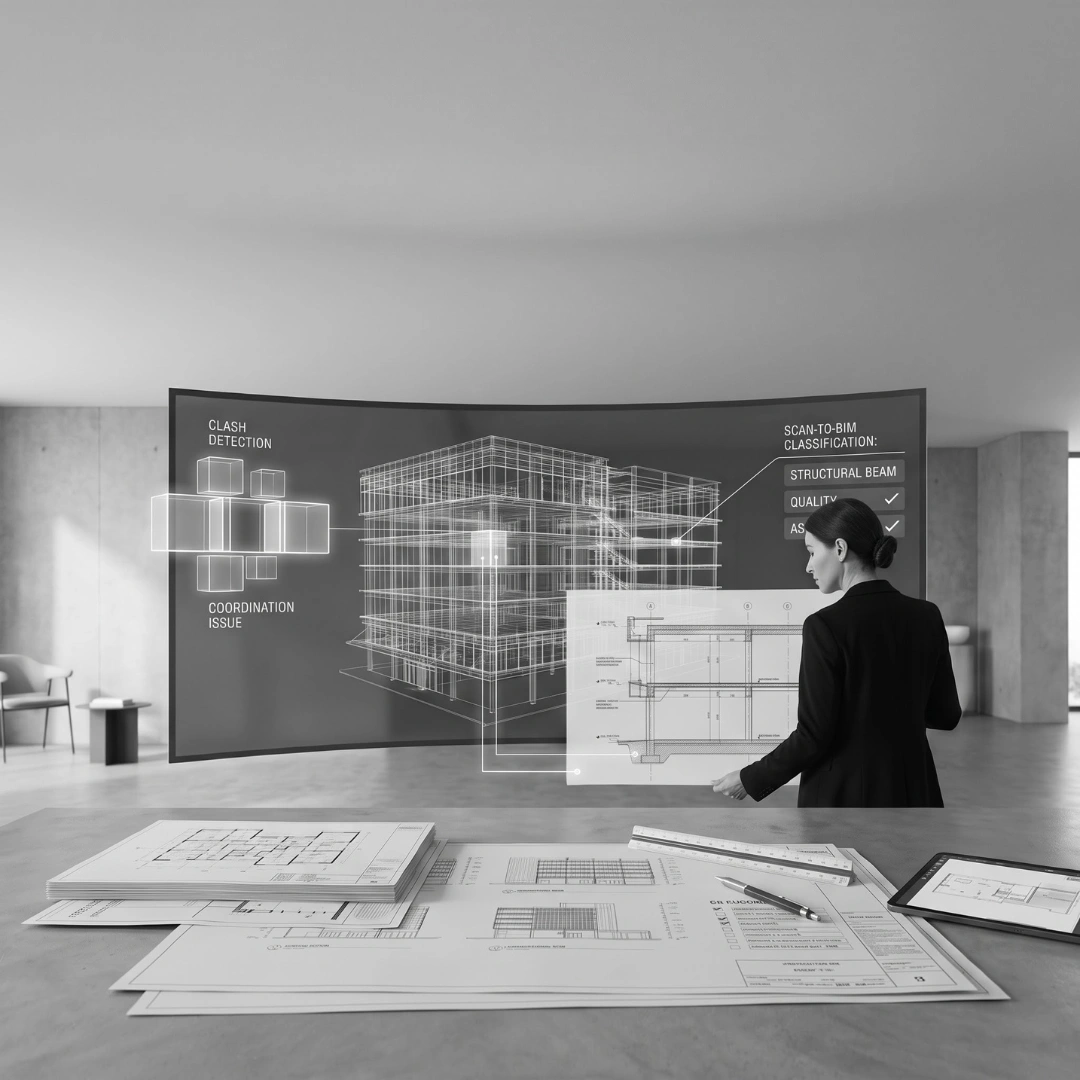
Stage 2: 3D Clash Detection (BIM Coordination)
Once documentation approaches completion, comprehensive 3D clash detection systematically identifies geometric conflicts.
BIM Model Federation:
Combine 3D models from all disciplines into a federated model:
Architectural Revit model, structural Revit or Tekla model, mechanical services Revit model, electrical services Revit model, plumbing and fire services models, all aligned in a common coordinate system.
This federated model represents a complete three-dimensional building as-designed across all disciplines.
Automated Clash Detection:
Run automated clash detection software, analyzing every geometric intersection across all disciplines:
Software checks millions of potential intersections, identifying where elements from different disciplines occupy the same three-dimensional space. This comprehensive checking catches conflicts that human review would miss.
Clash detection runs typically identify 500-2,000 clashes on the first run for commercial projects. Many are minor or easily resolved, but systematic identification ensures nothing is missed.
Clash Review and Triage:
Review identified clashes categorizing by severity and resolution approach:
Critical clashes: Major conflicts requiring design changes and stopping construction if not resolved. Examples: structural beams through major ductwork, columns in doorways, and major services conflicts.
Moderate clashes: Conflicts requiring resolution but with straightforward solutions. Examples: minor services spacing adjustments, coordination sequencing changes.
Minor clashes: Small clearance issues or false positives not requiring action. Examples: insulation thicknesses overlapping slightly, modeling tolerances creating apparent clashes.
False positives: Software-identified clashes that aren't real issues. Examples: intentional penetrations flagged as clashes, temporary construction elements.
Prioritized clash resolution focuses effort on genuine issues requiring design coordination.
Iterative Resolution:
Resolve clashes through coordinated design adjustments:
Hold coordination meetings reviewing clashes and determining solutions. Document resolution decisions. Update models reflecting agreed changes. Rerun clash detection, confirming resolutions haven't created new conflicts.
This iterative process continues until clash detection runs identify only minor acceptable clashes and false positives. Typically requires 3-5 coordination cycles, reducing clashes from an initial 500-2,000 toa final 20-50 acceptable minor items.
Stage 3: Pre-Construction Resolution
Before construction begins, confirm all coordination issues are resolved and documented.
Coordinated Documentation:
Update 2D documentation reflecting all 3D coordination outcomes:
Clash resolution decisions made in 3D models must translate to construction documents. Drawings update showing coordinated locations, adjusted routes, and modified configurations.
Coordination notes added to drawings documenting critical coordination decisions and installation sequences.
Coordination Drawings:
Produce multi-discipline coordination drawings showing all services overlaid in critical areas:
Ceiling coordination plans showing all services, structure, and architectural elements at each ceiling level. Vertical coordination sections showing floor-to-floor services, stacking, and clearances. Plant room and riser coordination plans showing dense service areas in three dimensions.
These coordination drawings provide installers with a comprehensive reference showing exactly how all elements fit together.
Trade Coordination Meetings:
Conduct pre-construction meetings with trade contractors, reviewing coordination:
Walk through coordination drawings with mechanical, electrical, plumbing, fire protection, and other trades. Confirm each trade understands their installation sequence, interfaces with other trades, and their coordination responsibilities.
Address questions and concerns before construction begins rather than discovering them on site.
Stage 4: Construction-Ready Documentation
Deliver a documentation package enabling a smooth construction start.
Complete Drawing Sets:
Ensure all disciplines provide complete, coordinated drawing sets:
No placeholder notes saying "coordinate on site" or "by others." All interfaces between disciplines are clearly detailed. All penetrations are sized and located. All connection details provided.
Complete documentation prevents RFIs from requesting missing information.
Specifications Aligned:
Verify specifications match coordinated drawings:
Equipment capacities and models match what's shown. Materials and finishes align with architectural intent. Performance requirements are achievable with documented systems.
Specification-drawing alignment prevents clarification requests and change order disputes.
Buildability Review:
Review documentation from a construction perspective, identifying potential installation challenges:
Access for installation is considered. Sequence dependencies identified. Special equipment needs documented. Temporary works requirements anticipated.
Buildability review catches practical construction issues that technically correct documentation might overlook.
Stage 5: Ongoing Construction Support
Continue coordination support during construction, addressing unforeseen issues.
Coordination RFI Response:
Respond quickly to any coordination issues discovered during construction:
Despite thorough pre-construction coordination, some issues emerge based on site conditions, means and methods, or as-built variations from design. Maintain coordination team availability for rapid response.
Quick response to construction coordination questions prevents delays.
Shop Drawing Review Coordination:
Review shop drawings, ensuring they maintain coordination:
Trade shop drawings sometimes diverge from coordinated design. Equipment sizes change. Routes optimize for fabrication efficiency. Details adjust for installation methods.
Shop drawing review confirms these adjustments maintain coordination and don't reintroduce conflicts resolved during design.
As-Built Coordination Updates:
Track as-built conditions, updating coordination models:
As construction proceeds, document the actual installed locations. Minor field adjustments accumulate. Maintaining updated coordination models supports remaining construction and provides accurate as-built records for facility management.
BIM Coordination vs. Traditional Methods
Comparing systematic 3D coordination against traditional approaches quantifies the improvement value.
Clash Detection Capability:
Traditional 2D review: Catches approximately 40-60% of coordination issues before construction. Most obvious major conflicts were identified, but many smaller issueswere missed.
3D clash detection: Identifies 90-95% of coordination issues before construction. Systematic checking catches conflicts that human review misses. The remaining 5-10% represents issues arising from as-built variations, means and methods, or unforeseen site conditions.
RFI Reduction Statistics:
Based on analysis of 600+ Australian construction projects comparing traditionally coordinated versus BIM-coordinated approaches:
Average project RFIs - Traditional coordination: 200-300 RFIs Average project RFIs - BIM coordination: 40-80 RFIs RFI reduction: 60-80%
This reduction eliminates $160,000-350,000 in RFI-related costs on typical $10M projects.
Schedule Impact:
Traditional coordination: Projects typically run 8-15% over the planned schedule due to coordination delays and rework.
BIM coordination: Projects typically run 0-5% over the planned schedule, with coordination issues representing minor rather than major delay contributors.
For a 52-week construction program, this represents 4-10 weeks of schedule improvement, reducing preliminary costs and enabling earlier occupancy.
Quality and Rework:
Traditional coordination: Approximately 5-8% of the construction cost represents coordination-related rework.
BIM coordination: Rework reduces to 1-3% of construction cost, primarily from non-coordination issues like design evolution and client changes.
This represents $400,000-500,000 in rework savings on $10M projects.
Cost-Benefit Analysis:
BIM coordination services typically cost 0.5-1.5% of construction value, depending on project complexity. For a $10M project, that's $50,000-150,000.
Benefits from coordination: RFI cost reduction: $160,000-350,000, Schedule improvement: $180,000-300,000, Rework reduction: $400,000-500,000, Total benefit: $740,000-1,150,000
Return on investment: 5:1 to 10:1
Even considering only direct quantifiable benefits, comprehensive coordination providesa substantial positive return on investment.
Implementing Coordination Processes for Your Projects
Understanding the coordination value, the question becomes how to implement it for your construction projects.
When to Engage Coordination Services:
Engage coordination services during design development, ideally before documentation begins:
Early engagement allows coordination to inform design decisions rather than forcing changes to completed documentation. Most effective coordination happens progressively throughout design, not as a final review before construction.
Engage coordination specialists as soon as design consultants are appointed. Coordination runs parallel to design development.
What to Expect from the Coordination Process:
Understanding the coordination process helps set appropriate expectations:
Timeline: Comprehensive coordination adds 2-4 weeks to the documentation schedule but reduces overall project delivery time through smoother construction. The documentation extension is an investment preventing construction delays.
Consultant involvement: All design consultants participate in coordination through model provision, clash review meetings, and design adjustments. Coordination isn't outsourced to a third party independently; it's a collaborative process.
Iterations: Expect multiple coordination cycles. First clash detection identifies hundreds or thousands of issues. Subsequent cycles progressively reduce clashes as resolutions are implemented. Final cycle confirms clean coordination.
Documentation updates: Coordination outcomes must be reflected in construction documentation. Budget time and consultant fees for post-coordination drawing updates.
Evaluating Coordination Quality:
Not all coordination services provide equal value. Evaluate coordination providers on:
Process rigor: Comprehensive systematic approach versus superficial review. Ask about clash detection methodology, review cycles, and resolution tracking.
Experience and capability: Team experience with Australian construction and relevant project types. BIM software proficiency and clash detection expertise.
Communication approach: Clear reporting of issues and resolutions. Collaborative coordination meetings. Responsive to questions and concerns.
Track record: Reference projects demonstrating RFI reduction and successful coordination outcomes.
Request case studies showing before/after statistics on comparable projects.
Integration with project team: Coordination services that work collaboratively with design consultants and builders rather than operating independently. Successful coordination requires team buy-in, not imposed external review.
FAQ: Construction Coordination Questions
How much does comprehensive BIM coordination cost?
BIM coordination services typically cost 0.5-1.5% of construction value, depending on project size and complexity. For a $10M project, expect $50,000-150,000. Larger projects benefit from economies of scale with lower percentage costs. Complex projects with dense services require more coordination effort. This investment typically returns 5-10 times its cost through RFI reduction, schedule improvement, and rework elimination. Compare coordination cost against average coordination-related project costs of $680,000 (6.8% of construction value) to assess value.
When should coordination start in the project timeline?
Start coordination during design development, ideally before detailed documentation begins. Early coordination informs design decisions, preventing issues rather than forcing changes to completed documentation. The optimal approach includes coordination workshops at 25%, 50%, and 75% design completion, followed by comprehensive clash detection at 90-95% completion. Starting coordination after documentation completes still provides value, but requires more extensive revisions. Starting during early design provides maximum benefit at the lowest disruption.
Can coordination eliminate all RFIs?
Coordination typically reduces RFIs by 60-80% but doesn't eliminate them entirely. Remaining RFIs arise from unforeseen site conditions, as-built variations from design, means and methods decisions, client changes during construction, and authority requests for clarification. Coordination catches design and documentation issues, but can't address circumstances that only become apparent during construction. Expect well-coordinated projects to generate 40-80 RFIs compared to 200-300 for traditionally coordinated projects of similar scope.
What if our design consultants already coordinate internally?
Most design consultants perform basic coordination within their scope and reasonable coordination with other disciplines. However, consultant coordination typically relies on 2D review and catches 40-60% of issues. Comprehensive 3D coordination using systematic clash detection identifies the additional 30-40% of conflicts that 2D review misses. Independent coordination also provides an objective third-party review without potential blind spots from familiarity. Even with diligent consultant coordination, additional systematic coordination adds substantial value through comprehensive checking.
How long does the coordination process take?
Comprehensive coordination adds 2-4 weeks to the documentation timeline for typical projects. This includes initial clash detection (1-2 days), first coordination review and resolution planning (3-5 days), consultant design adjustments (1-2 weeks), subsequent clash detection cycles (2-3 iterations of 3-5 days each), and final verification. While this extends the documentation phase, it prevents construction delays that would far exceed this time. The 2-4 week investment typically prevents 4-10 weeks of construction delays, providing a net schedule benefit.
Building Coordination Into Your Workflow
Construction document coordination issues represent one of the most expensive yet preventable sources of construction delays and cost overruns. The systematic 5-stage coordination framework outlined in this guide provides Australian builders with a proven methodology for eliminating 60-80% of coordination-related RFIs while improving construction efficiency and schedule performance.
Key implementation strategies include engaging coordination services during design development rather than after documentation completion, ensuring all design consultants actively participate in the coordination process, conducting iterative clash detection and resolution cycles, updating construction documentation to reflect all coordination outcomes, and maintaining coordination support during construction for emerging issues.
While comprehensive coordination adds 0.5-1.5% to project costs, it typically returns 5-10 times its investment through RFI reduction, schedule improvement, and rework elimination. For a $10M project, a $100,000 coordination investment prevents $500,000-1,000,000 in coordination-related delays and rework.
The choice isn't whether to coordinate, but whether to coordinate proactively before construction or reactively during construction. Proactive coordination costs less, delivers better outcomes, and prevents the daily frustration of managing avoidable coordination issues while trying to build efficiently.
Obelisk has provided comprehensive BIM coordination and clash detection services for Australian builders since 2010, systematically reducing RFIs by 60-80% across 600+ construction projects. Our 5-stage coordination framework, experienced coordination specialists, and collaborative approach with design teams help builders achieve smooth construction delivery without coordination chaos.
When construction efficiency matters and every RFI represents lost time and money, systematic coordination transforms documentation from problem source to construction enabler.
Stop Fighting Coordination Issues During Construction
Obelisk provides comprehensive BIM coordination and clash detection services that eliminate 60-80% of construction RFIs before site mobilization.
✓ 3D Clash Detection: Systematic identification of all coordination conflicts
✓ Multi-Discipline Coordination: Architectural, structural, and MEP integration
✓ Australian Standards: Compliant with local construction practices and codes
✓ Proven Results: Average 60-80% RFI reduction on coordinated projects
✓ Construction-Ready Documentation: Complete, coordinated drawing packages
✓ Ongoing Support: Construction phase coordination assistance
We help Australian builders eliminate costly coordination delays and deliver projects efficiently.
Get Your Free Project Coordination Assessment: team@obelisk.au
TABLE OF CONTENTS



















.png)
.png)
.webp)