


Construction Drawing Costs in Australia: In-House vs Outsourcing Comparison 2026
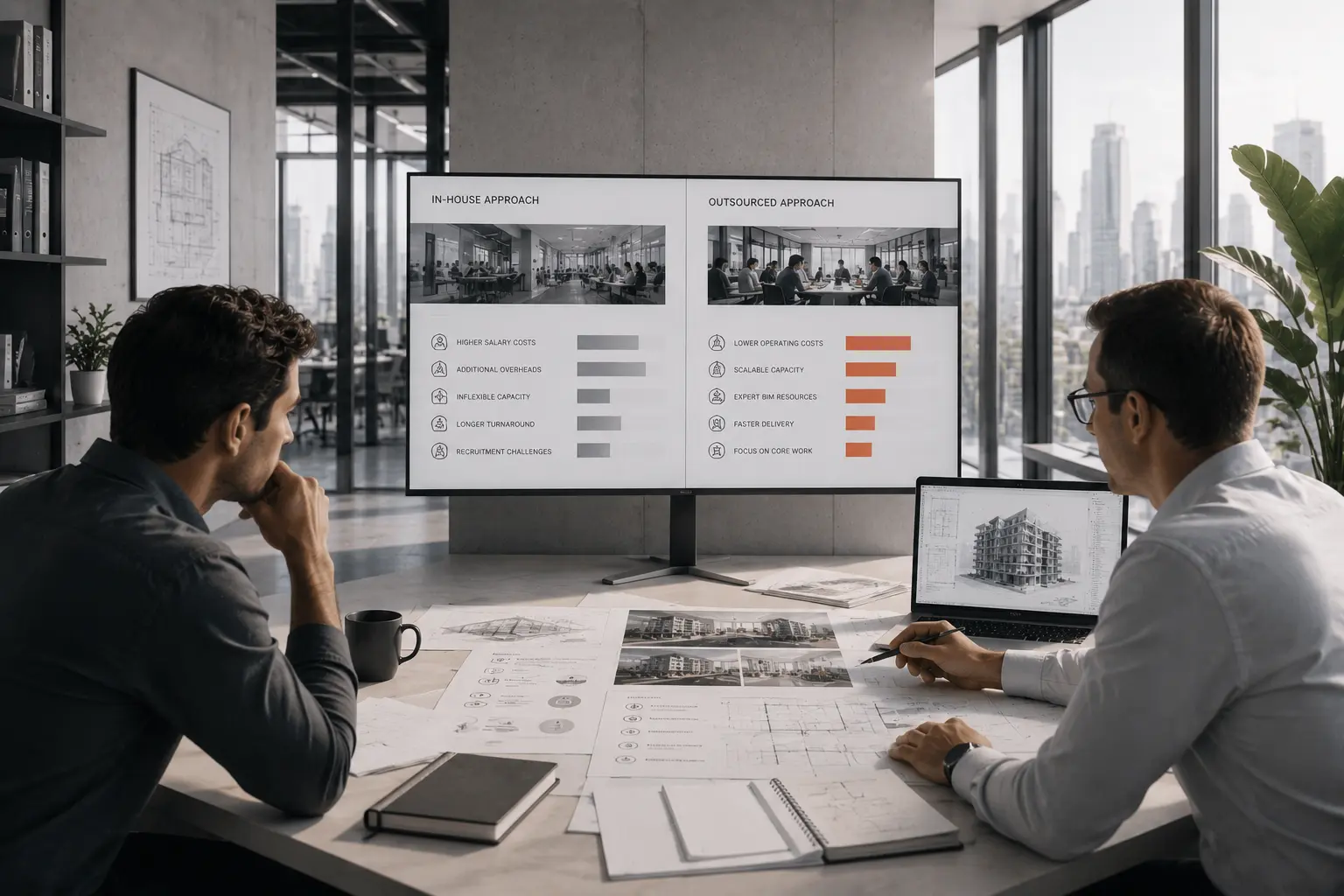
Your construction company needs consistent documentation support for projects. Shop drawings, coordination drawings, and as-built documentation consume time and resources. The question facing many builders is straightforward: should you maintain in-house drafting staff or outsource documentation to specialist providers?
On the surface, in-house appears cheaper. You pay salaries, provide software and workspace, and drafting capacity sits ready when needed. Outsourcing shows higher hourly rates creating the perception of expensive external services versus affordable internal staff.
This perception is misleading. When you calculate true fully-loaded costs including salary, superannuation, leave entitlements, software, hardware, workspace, recruitment, training, and management time, in-house drafting typically costs $85-125 per productive hour. Outsourced services range $45-75 per hour at 2026 Australian market rates. The apparent cost advantage reverses when accounting for all expenses.
This comprehensive cost comparison provides Australian builders with transparent analysis of documentation costs across both approaches. You'll learn the true fully-loaded cost of in-house staff, complete outsourcing pricing structures, hidden costs most builders overlook, and decision frameworks determining which approach makes financial sense for your specific situation.
The True Cost of In-House Drafting Teams
Understanding complete in-house costs requires examining every expense component, not just base salary.
Direct Salary Costs (2026 Australian Market Rates)
Construction drafters and documentation coordinators command market salaries reflecting skill levels and experience:
Junior drafters (0-2 years experience): $55,000-68,000 annually. Basic CAD or Revit skills, require supervision and quality checking. Suitable for simple shop drawings and basic documentation under direction.
Mid-level drafters (3-5 years experience): $68,000-82,000 annually. Competent independent work on standard documentation. Proficient in CAD and increasingly Revit. Can handle shop drawings, coordination drawings, and routine as-built documentation with minimal supervision.
Senior drafters (5+ years experience): $82,000-95,000 annually. Advanced technical skills, can manage complex coordination, lead documentation projects. BIM proficiency and understanding of construction sequencing. Limited availability in market.
These salaries represent direct base pay before any employment on-costs, benefits, or operational expenses. For cost analysis, we'll use mid-level drafter at $75,000 annual salary as baseline.
Employment Overheads and On-Costs
Base salary represents only 65-75% of total employment cost. Mandatory and typical on-costs add substantially:
Superannuation (mandatory): 11% of ordinary time earnings in 2026 = $8,250 annually on $75,000 salary.
Annual leave: 4 weeks (160 hours) at full pay = $5,769 annually (calculated as 7.69% of base salary for annual leave loading).
Sick leave and personal leave: Average 10 days usage annually = $2,885.
Public holidays: 11 days annually when not worked = $3,173.
Workers compensation insurance: Approximately 1.5-3% of wages for office/clerical work = $1,125-2,250 annually.
Payroll tax: Applicable in most states when total payroll exceeds thresholds. Approximately 4.85-5.45% on wages above threshold. For this analysis, assume $3,750 annually.
Long service leave accrual: Approximately 0.87% of salary = $650 annually.
Total on-costs: $25,602-26,727 annually (34-36% of base salary)
Total direct employment cost: $100,602-101,727 annually for mid-level drafter
Technology and Software Costs
Construction documentation requires substantial software investment:
CAD software (AutoCAD or similar): $2,800-3,500 per seat annually including subscription and updates.
BIM software (Revit): $3,800-4,500 per seat annually. Increasingly essential as industry moves to BIM.
Coordination and clash detection (Navisworks, BIM 360): $2,500-3,500 annually if required.
Rendering and visualization tools: $1,200-2,000 annually if producing presentation materials.
PDF management and markup tools (Bluebeam): $500-800 annually.
Project collaboration platforms: $600-1,200 annually per user.
Total software cost per drafter: $6,400-9,500 annually for comprehensive toolset. Use $8,000 as mid-point.
Workspace and Infrastructure
Office space and equipment create additional costs often overlooked:
Workspace allocation: Commercial office space in Sydney/Melbourne costs $400-600 per square meter annually. Typical drafter workspace requires 8-10 square meters including desk, circulation, and share of common areas. Annual workspace cost: $3,200-6,000. Use $4,500 as mid-point.
Hardware (computer workstation): Drafting workstations require capable computers. Quality workstation costs $2,500-4,000 with 3-4 year replacement cycle. Amortized annual cost: $625-1,250.
Monitors and peripherals: Dual monitors essential for drafting productivity. Additional peripherals (keyboard, mouse, digitizer if used). Total setup $800-1,500 with 4-5 year life. Annual amortized cost: $200-350.
Furniture (desk, chair, storage): Quality ergonomic furniture costs $2,000-3,500 with 7-10 year life. Annual amortized cost: $250-400.
IT infrastructure allocation: Network, server, backup, IT support allocated per user. Annual cost per user: $800-1,500.
Total workspace and infrastructure: $5,575-9,500 annually. Use $7,500 as mid-point.
Training and Development
Maintaining current skills and software proficiency requires ongoing investment:
Software training and updates: 10-20 hours annually learning new features, updates, and best practices. At productive hour cost, represents $1,000-2,500 value.
Professional development: Courses, certifications, industry events. $1,500-3,000 annually for engaged professional development.
Internal training time: Learning company standards, project-specific requirements, process updates. 15-25 hours annually at productive hour rates.
Total training investment: $3,500-6,500 annually. Use $5,000 as mid-point.
Management and Supervision Time
In-house staff require management and coordination consuming senior team time:
Daily coordination and task assignment: 15-30 minutes daily = 65-130 hours annually at project manager/coordinator rates ($120-150/hour) = $7,800-19,500.
Performance management: Reviews, feedback, development discussions. 20-30 hours annually = $2,400-4,500.
Quality review and checking: Senior review of drafter output before issue. Varies by project but typically 15-25% of drafter production time represents senior review time.
Administration: Timesheets, leave management, HR coordination. 10 hours annually = $1,200-1,500.
Total management overhead: $11,400-25,500 annually. Use $18,000 as mid-point (conservative estimate).
Total Fully-Loaded In-House Cost
Combining all cost components for mid-level drafter:
Cost Component
Annual Cost
Base salary
$75,000
Employment on-costs
$25,600
Software
$8,000
Workspace & infrastructure
$7,500
Training & development
$5,000
Management & supervision
$18,000
Total annual cost
$139,100
Productive Hours and Hourly Cost
Not all employment hours produce billable output. Realistic productive hour calculation:
Total annual work hours: 52 weeks × 38 hours = 1,976 hours
Subtract non-productive time:
- Annual leave: 152 hours (4 weeks)
- Sick/personal leave average: 76 hours (10 days)
- Public holidays: 83 hours (11 days)
- Training and meetings: 80 hours
- Administrative tasks: 60 hours
- Normal workplace inefficiency: 100 hours (approximately 5% of remaining time)
Total non-productive hours: 551 hours
Productive hours annually: 1,425 hours (72% utilization)
Fully-loaded cost per productive hour: $139,100 ÷ 1,425 hours = $97.60 per hour
This represents true cost per productive hour of documentation output from mid-level in-house drafter when accounting for all expenses and realistic productivity.
Outsourced Drafting Services: Complete Pricing Breakdown
Understanding outsourced service pricing requires examining rate structures and what's included versus additional.
Hourly Rate Structures
Australian construction documentation services typically charge hourly rates varying by service type and complexity:
Basic CAD drafting: $45-55 per hour. Simple 2D shop drawings, basic as-built documentation, straightforward detailing. Suitable for routine, non-complex documentation.
Standard documentation services: $55-65 per hour. Typical shop drawings, coordination drawings, standard as-built documentation. Covers majority of construction documentation needs.
BIM and 3D coordination: $65-75 per hour. Revit modeling, 3D coordination drawings, clash detection, complex MEP coordination. Specialist skills commanding higher rates.
Rush or expedited services: 20-40% premium above standard rates. Fast-track documentation meeting tight deadlines.
After-hours or weekend work: 25-50% premium if required, though many providers include standard turnaround without premium.
For cost comparison, use $60 per hour as representative mid-point for standard construction documentation services.
Project-Based Pricing Models
Many providers offer fixed-price project quotes as alternative to hourly billing:
Shop drawing packages: Fixed price based on scope and complexity. Typical pricing for mechanical, electrical, or structural shop drawing set: $3,500-8,500 depending on project size and detail level.
Coordination drawing sets: Fixed pricing for complete coordination documentation. Typical range: $5,000-15,000 based on project complexity and building systems.
As-built documentation: Project-based pricing for complete as-built package. Range: $4,000-12,000 depending on project scope.
Project-based pricing provides cost certainty but requires well-defined scope. Scope changes typically billed hourly at agreed rates.
Retainer and Volume Pricing
Builders with ongoing documentation needs often negotiate volume or retainer arrangements:
Monthly retainer structures: Commit to minimum monthly hours (40, 60, 80 hours common levels) at discounted rate. Typical discount: 10-15% below standard hourly rates for volume commitment.
Volume discounts: Graduated discounting based on annual hours. Typical structure: 5% discount at 500+ hours annually, 10% discount at 1,000+ hours, 15% discount at 2,000+ hours.
Preferred provider arrangements: Relationship-based pricing for builders providing consistent work. Rates negotiated based on expected annual volume and project types.
What's Included vs Additional Costs
Understanding what outsourcing rates include prevents surprise costs:
Typically included in standard rates:
- Software (CAD, Revit, coordination tools)
- Hardware and computing infrastructure
- Quality review and checking before delivery
- Minor revisions within reasonable scope
- Standard communication and coordination
- File management and organization
Potential additional costs:
- Extensive revisions due to scope changes (hourly billing)
- Site visits or meetings if required (travel time and expenses)
- Printing or physical deliverables (most work digital)
- Expedited delivery premiums
- Specialized software or analysis beyond standard scope
Communication and coordination time: Most reputable providers include reasonable coordination time in rates. Excessive coordination time (daily calls, constant changes, unclear direction) may attract additional charges or impact pricing for future work.
For budgeting purposes, builders should assume outsourced documentation costs approximately 5-10% above quoted hourly rates when accounting for minor scope variations and normal project communication.
The Hidden Costs Most Builders Miss
Several cost factors escape typical analysis but significantly impact true economics.
Underutilization and Idle Time
In-house staff represent fixed costs whether work exists or not. Construction documentation demand fluctuates with project cycles:
During busy periods, in-house capacity may prove insufficient requiring outsourcing anyway or declining work. During slow periods, staff sit underutilized consuming full employment costs while producing limited output.
Realistic scenario: Builder with in-house drafter experiences workload fluctuating from 60 hours monthly (slow) to 180 hours monthly (busy), averaging 110 hours monthly. The drafter's cost remains constant at $11,600 monthly ($139,100 ÷ 12) whether producing 60 or 180 hours output.
Utilization rate calculation:
- Average monthly output: 110 hours
- Maximum productive capacity: 119 hours monthly (1,425 annual ÷ 12)
- Actual utilization: 92% of capacity
This 92% represents optimistic utilization. Many builders experience 70-85% utilization rates when accounting for workload valleys.
Recruitment and Turnover Costs
When in-house drafters leave, substantial recruitment costs occur:
Recruitment expenses: Advertising ($1,500-3,000), recruitment agency fees if used (15-20% of annual salary = $11,250-15,000 for $75K role), interview time from senior staff (20-30 hours at $120-150/hour = $2,400-4,500).
Productivity loss during notice period: Departing employee productivity typically drops 30-50% during notice period (4 weeks typical). Lost productivity value: $1,500-2,500.
Training and onboarding new hire: 3-4 weeks reduced productivity while learning systems, standards, and projects. Cost of reduced productivity and training time: $4,000-6,000.
Total replacement cost: $20,650-31,000 per turnover event.
Industry average tenure for mid-level drafters: 2.5-3.5 years. Amortized annual turnover cost: $6,000-12,000.
Leave Coverage and Sick Days
When in-house staff take leave, work either waits (causing delays), gets handled by other staff (reducing their productivity), or requires temporary coverage (additional cost).
Four weeks annual leave plus sick days means approximately 6 weeks annually where coverage is required. Options include work backlog creating delays, other staff absorbing workload (reducing their core productivity), or temporary staff (costly and often unavailable at short notice).
Most builders experience some combination creating hidden costs through delayed deliverables and reduced team productivity estimated at $3,000-6,000 annually.
Quality and Rework Costs
In-house staff skill levels vary. Junior and mid-level drafters produce work requiring review and often rework. Estimated rework time: 10-20% of documentation time consuming senior staff hours for review and correction.
For in-house drafter, quality review and rework costs approximately $8,000-15,000 annually in senior staff time. This partially captured in management time but represents real cost of ensuring output quality.
Specialist outsourced providers typically deliver higher first-time quality through experienced staff and internal quality processes, reducing builder review and rework burden.
Capacity vs Demand Mismatch
The fundamental economic challenge of in-house teams is matching fixed capacity to variable demand. You need documentation capacity for peak periods but must pay for capacity during average and slow periods.
Scenario: Builder's monthly documentation needs fluctuate from 40 hours (slow) to 160 hours (busy), averaging 95 hours monthly.
In-house approach: Hire drafter providing 119 hours monthly capacity at fixed $11,600 monthly cost. During slow months, pay full cost for 40 hours work ($290/hour effective cost). During average months, pay $11,600 for 95 hours ($122/hour). Only during busy months does utilization approach full capacity.
Outsourcing approach: Pay $60/hour × actual hours needed. Slow months: $2,400. Average months: $5,700. Busy months: $9,600. Perfect capacity matching without paying for unused capacity.
This mismatch represents the core economic case for outsourcing when workload varies substantially.
Side-by-Side Cost Comparison: Real Numbers
Three scenarios illustrate economics for different builder situations using 2026 Australian market costs.
Scenario 1: Small Builder (Occasional Documentation Needs)
Profile: Small builder managing 4-8 projects annually requiring occasional shop drawings and coordination documentation. Average 45 hours monthly documentation (540 hours annually).
In-House Approach:
- Annual cost: $139,100 (one mid-level drafter)
- Productive capacity: 1,425 hours annually
- Actual utilization: 540 hours (38% utilization)
- Effective cost per hour: $257.60
Outsourcing Approach:
- Hours required: 540 annually
- Rate: $60/hour
- Annual cost: $32,400
- Effective cost per hour: $60.00
Cost Comparison:
- In-house annual cost: $139,100
- Outsourcing annual cost: $32,400
- Annual savings with outsourcing: $106,700
- ROI: 329% (outsourcing costs 23% of in-house)
Conclusion: At this volume, outsourcing delivers overwhelming cost advantage. In-house makes no economic sense.
Scenario 2: Mid-Sized Builder (Regular Documentation Requirements)
Profile: Mid-sized builder managing 15-25 projects annually with consistent documentation needs. Average 95 hours monthly documentation (1,140 hours annually).
In-House Approach:
- Annual cost: $139,100
- Productive capacity: 1,425 hours annually
- Actual utilization: 1,140 hours (80% utilization)
- Effective cost per hour: $122.02
Outsourcing Approach:
- Hours required: 1,140 annually
- Rate: $60/hour (negotiated volume discount to $57/hour)
- Annual cost: $64,980
- Effective cost per hour: $57.00
Cost Comparison:
- In-house annual cost: $139,100
- Outsourcing annual cost: $64,980
- Annual savings with outsourcing: $74,120
- ROI: 214% (outsourcing costs 47% of in-house)
Considerations: At this volume, outsourcing still delivers substantial cost advantage. In-house might be considered if recruitment is easy and work is extremely consistent, but economics favor outsourcing for most builders.
Scenario 3: Large Builder (Continuous Documentation Demand)
Profile: Large builder managing 30+ projects annually with continuous high-volume documentation needs. Average 165 hours monthly documentation (1,980 hours annually) requiring multiple drafters.
In-House Approach (2 drafters required):
- Annual cost: $278,200 (two mid-level drafters)
- Combined productive capacity: 2,850 hours annually
- Actual utilization: 1,980 hours (69% utilization)
- Effective cost per hour: $140.51
Outsourcing Approach:
- Hours required: 1,980 annually
- Rate: $60/hour standard, but volume discount to $54/hour
- Annual cost: $106,920
- Effective cost per hour: $54.00
Cost Comparison:
- In-house annual cost: $278,200
- Outsourcing annual cost: $106,920
- Annual savings with outsourcing: $171,280
- ROI: 260% (outsourcing costs 38% of in-house)
Alternative Analysis - Hybrid Approach:
- One in-house drafter for baseline capacity: $139,100
- Outsource overflow (840 hours annually): $45,360
- Total hybrid cost: $184,460
- Savings vs full in-house: $93,740
- Provides flexibility and some internal capacity
Conclusion: Even at high volumes where in-house traditionally appears economical, outsourcing often remains cost-effective due to fully-loaded employment costs. Hybrid approach provides middle ground.
ROI Analysis: When Does Each Approach Make Sense?
Decision framework helps builders determine optimal approach for their specific situation.
Break-Even Analysis
Break-even occurs where in-house and outsourcing costs equal. Using our fully-loaded in-house cost of $139,100 annually and outsourcing rate of $60/hour:
Break-even calculation: $139,100 ÷ $60/hour = 2,318 hours annually
Monthly break-even: 193 hours monthly
Above 193 hours monthly consistent documentation demand, in-house begins approaching cost-competitiveness with outsourcing. Below this threshold, outsourcing delivers clear cost advantage.
Critical reality check: 193 hours monthly exceeds the productive capacity of single drafter (119 hours monthly maximum). Therefore, break-even requires at least two full-time drafters working at near-full capacity consistently.
Most builders don't maintain documentation demand supporting two full-time drafters consistently, making outsourcing economically superior for majority of builders.
Volume Thresholds
Economic decision points based on monthly documentation volume:
0-60 hours monthly: Outsourcing overwhelmingly cost-effective. In-house makes no economic sense.
60-100 hours monthly: Outsourcing strongly favored. In-house costs 2-3× more than outsourcing.
100-140 hours monthly: Outsourcing still economically superior but margin narrows. Consider outsourcing with confidence.
140-180 hours monthly: Economic decision depends on consistency. If volume is consistent year-round, in-house becomes viable. If volume fluctuates, outsourcing remains better choice.
180+ hours monthly: In-house becomes economically competitive if you can recruit and retain quality staff. Hybrid approach often optimal: core in-house team plus outsourced overflow.
Project Type Considerations
Beyond volume, project characteristics influence optimal approach:
Highly repetitive projects (residential subdivisions, industrial sheds): Favor in-house where familiarity with standard details provides efficiency.
Diverse project types (commercial, industrial, institutional varied work): Favor outsourcing accessing specialist expertise for different project types.
Fast-track projects with tight deadlines: Favor outsourcing providing flexible capacity surge.
Long-duration projects with steady documentation pace: May favor in-house for continuity.
Complex coordination-heavy projects: Favor specialist outsourcing with advanced BIM and coordination capabilities.
Geographic and Market Factors
Location impacts both in-house and outsourcing economics:
Major metro markets (Sydney, Melbourne): Higher salaries ($75K-95K) and workspace costs favor outsourcing economics. Larger talent pool makes recruitment easier if choosing in-house.
Regional markets: Lower salaries ($60K-75K) and workspace costs improve in-house economics. Limited talent pool makes recruitment challenging. Outsourcing provides access to capability unavailable locally.
Remote/rural markets: In-house recruitment very difficult. Outsourcing often only viable option regardless of volume.
Quality and Service Level Considerations
Cost comparison captures most decision factors but quality and service warrant consideration.
Expertise Access and Specialization
In-house advantage: Staff develops deep familiarity with your projects, standards, and preferences. Continuity on long-duration projects. Immediate availability for questions and clarifications.
Outsourcing advantage: Access to specialist expertise (complex BIM, specialized building types, advanced coordination) not justified for full-time hire. Broader experience across diverse projects bringing best practices. Investment in latest software and training you'd struggle to justify for single staff member.
Flexibility and Scalability
In-house limitation: Fixed capacity struggles with workload peaks. Hiring additional staff for temporary demand surge impractical. Slow to scale up or down.
Outsourcing advantage: Perfect capacity matching to actual needs. Scale from 20 hours to 200 hours monthly without hiring decisions. No cost during slow periods. Immediate access to additional capacity during busy periods.
Turnaround Times
In-house advantage: Immediate access during business hours. No communication lag. Can prioritize urgent items instantly.
Outsourcing reality: Professional providers deliver work within 24-48 hours for standard documentation, 3-5 days for complex packages. Rush services available at premium. Communication typically same-day response. For most builder needs, outsourcing turnaround proves adequate.
Risk and Liability
In-house consideration: Builder maintains full control and oversight. Documentation errors remain builder's responsibility regardless but direct supervision provides comfort.
Outsourcing consideration: Reputable providers carry professional indemnity insurance and maintain quality processes. Contracts define liability and responsibility. Risk profile similar to in-house when using established providers.
Making the Decision: Cost-Based Framework
Systematic approach guides builder-specific decision.
Step 1: Calculate Your Actual Documentation Volume
Review past 12-24 months of projects. Calculate average monthly hours spent on shop drawings, coordination drawings, as-built documentation, and other drafting needs. Identify peak monthly demand versus average. Assess trend (increasing, stable, decreasing).
Step 2: Determine Your Workload Consistency
Calculate coefficient of variation in monthly hours. High variation (50%+ from month to month) strongly favors outsourcing. Low variation (<25%) makes in-house more viable economically.
Step 3: Assess Your Recruitment Reality
Can you recruit qualified drafters in your market? What's realistic salary required? How long does recruitment typically take? What's typical tenure once hired? If recruitment is difficult or uncertain, outsourcing eliminates this risk.
Step 4: Calculate Your Break-Even
Use your actual costs (salaries in your market, your workspace costs, your on-costs). Calculate fully-loaded hourly cost. Compare against outsourcing quotes for your typical work. Determine your break-even volume.
Step 5: Evaluate Hybrid Options
Consider combinations: small in-house team (1 person) for baseline capacity plus outsourced overflow; in-house coordination, outsourced production; specialized outsourcing (BIM, complex coordination) with in-house handling routine work.
Hybrid approaches often provide optimal balance of control, flexibility, and cost-effectiveness.
Step 6: Make Decision and Review
Choose approach best fitting your analysis. Implement for 6-12 months. Track actual costs and outcomes. Review and adjust if results don't match expectations.
FAQ: Construction Drawing Costs
What's the true hourly cost of in-house drafters?
Fully-loaded in-house drafting costs range $95-125 per productive hour for mid-level drafters in 2026 Australian market when accounting for salary ($75K average), employment on-costs (superannuation, leave, workers compensation, payroll tax totaling 34-36%), software ($8,000 annually), workspace and infrastructure ($7,500 annually), training ($5,000 annually), and management overhead ($18,000 annually). Total annual cost approximately $139,000 divided by realistic productive hours (1,425 annually accounting for leave, training, meetings, and normal inefficiency) yields $97.60 per productive hour. Many builders underestimate true cost by 40-60% when considering only salary.
At what volume does in-house become cheaper than outsourcing?
Break-even occurs at approximately 190-220 hours monthly of consistent documentation demand, which exceeds single drafter's productive capacity (119 hours monthly maximum). Therefore in-house becomes economically competitive only when supporting two or more full-time drafters at high utilization (1,800-2,400 annual hours minimum). Most small to mid-sized builders never reach volumes justifying in-house from pure cost perspective. For builders averaging under 140 hours monthly, outsourcing at $55-65/hour delivers 40-60% cost savings versus in-house even before considering flexibility benefits and recruitment challenges.
What hidden costs should builders account for when comparing options?
In-house hidden costs include underutilization during slow periods (paying full employment cost for reduced output), recruitment and turnover expenses ($20,000-30,000 per replacement), leave coverage requiring work delays or overtime from other staff, management and supervision time (15-25% overhead for coordination and quality review), and quality/rework costs from less experienced staff output. Outsourcing hidden costs include initial coordination time establishing standards and expectations (typically 5-10 hours for first project, minimal thereafter), minor scope changes requiring additional billable hours, and communication overhead for complex projects. Most builders find in-house hidden costs substantially exceed outsourcing hidden costs.
How do volume discounts work for outsourced drafting services?
Outsourcing providers typically offer graduated discounting based on committed volume. Common structures include retainer arrangements (commit minimum monthly hours receiving 10-15% discount), annual volume discounts (500-1,000 hours = 5% discount, 1,000-2,000 hours = 10% discount, 2,000+ hours = 15% discount), and preferred provider pricing for consistent clients providing regular work. Builders with 80-120 hours monthly needs can negotiate $54-58/hour rates versus standard $60-65/hour through volume arrangements. Pricing remains hourly or project-based but at discounted rates. These discounts improve outsourcing cost-effectiveness further, particularly for builders with consistent volume but not justifying in-house.
Should we consider hybrid approach combining in-house and outsourcing?
Hybrid approaches often provide optimal balance for mid-sized to large builders. Common models include core in-house drafter handling baseline continuous work plus outsourced capacity for overflow and peaks, in-house coordination and project management with outsourced production execution, in-house for standard familiar work with specialized outsourcing for complex BIM, coordination, or unfamiliar project types, and geographic split with in-house for local projects, outsourced for remote projects. Hybrid eliminates maintaining excess in-house capacity for peak demands while providing some internal capability and continuity. Builders averaging 100-160 hours monthly often find optimal economics with one in-house person plus outsourcing, versus two in-house drafters with frequent underutilization.
Cost-Effective Documentation Solutions
Construction drawing costs in Australia vary dramatically between in-house and outsourced approaches when accounting for complete fully-loaded expenses. The analysis reveals outsourcing typically costs 40-65% less than in-house for most builder scenarios when comparing true all-inclusive costs.
In-house mid-level drafters cost approximately $97-125 per productive hour accounting for salary, employment on-costs, software, workspace, training, and management. This compares to outsourcing rates of $55-65 per hour for standard documentation services. Only at very high volumes (190+ hours monthly consistently) does in-house approach cost competitiveness with outsourcing, requiring at least two full-time drafters working at high utilization.
For small builders (under 70 hours monthly), outsourcing delivers 60-75% cost savings. For mid-sized builders (70-140 hours monthly), outsourcing saves 40-55%. Even large builders (140+ hours monthly) often achieve 20-35% savings through outsourcing, with hybrid approaches providing middle ground combining some in-house capability with outsourced flexibility.
Beyond pure cost comparison, outsourcing eliminates recruitment challenges in tight talent markets, provides perfect capacity matching to variable workloads avoiding underutilization costs, delivers access to specialist expertise not justified for full-time hire, and eliminates management overhead for supervision and quality review.
The decision framework involves calculating actual documentation volume and consistency, assessing local recruitment feasibility and costs, determining break-even for your specific situation, evaluating hybrid options combining approaches, and making data-driven decisions based on your builder-specific economics rather than assumptions.
Obelisk provides cost-effective construction documentation services for Australian builders with transparent pricing, flexible capacity matching your actual needs, and specialist expertise across shop drawings, coordination drawings, and as-built documentation. Our systematic approach, quality processes, and understanding of Australian construction standards deliver documentation you need at competitive rates maximizing your project economics.
Cost-Effective Construction Documentation
Obelisk delivers professional construction drafting services at competitive Australian market rates with transparent pricing and flexible capacity.
✓ Transparent Pricing: Clear hourly and project-based rates with no hidden costs
✓ Volume Discounts: Competitive pricing for builders with regular documentation needs
✓ Flexible Capacity: Scale from 20 to 200+ hours monthly matching your actual requirements
✓ Australian Standards: Documentation meeting local construction and authority requirements
✓ Fast Turnaround: 24-48 hours standard delivery, rush services available
✓ Quality Assured: Systematic checking before delivery reducing your review burden
We help Australian builders optimize documentation costs while maintaining quality and delivery speed.
Request Detailed Pricing for Your Projects: team@obelisk.au
Cost-effective documentation solutions for Australian builders.
TABLE OF CONTENTS















.png)
.png)
.webp)