


Healthcare Facility Design Documentation: Compliance and BIM Requirements Australia
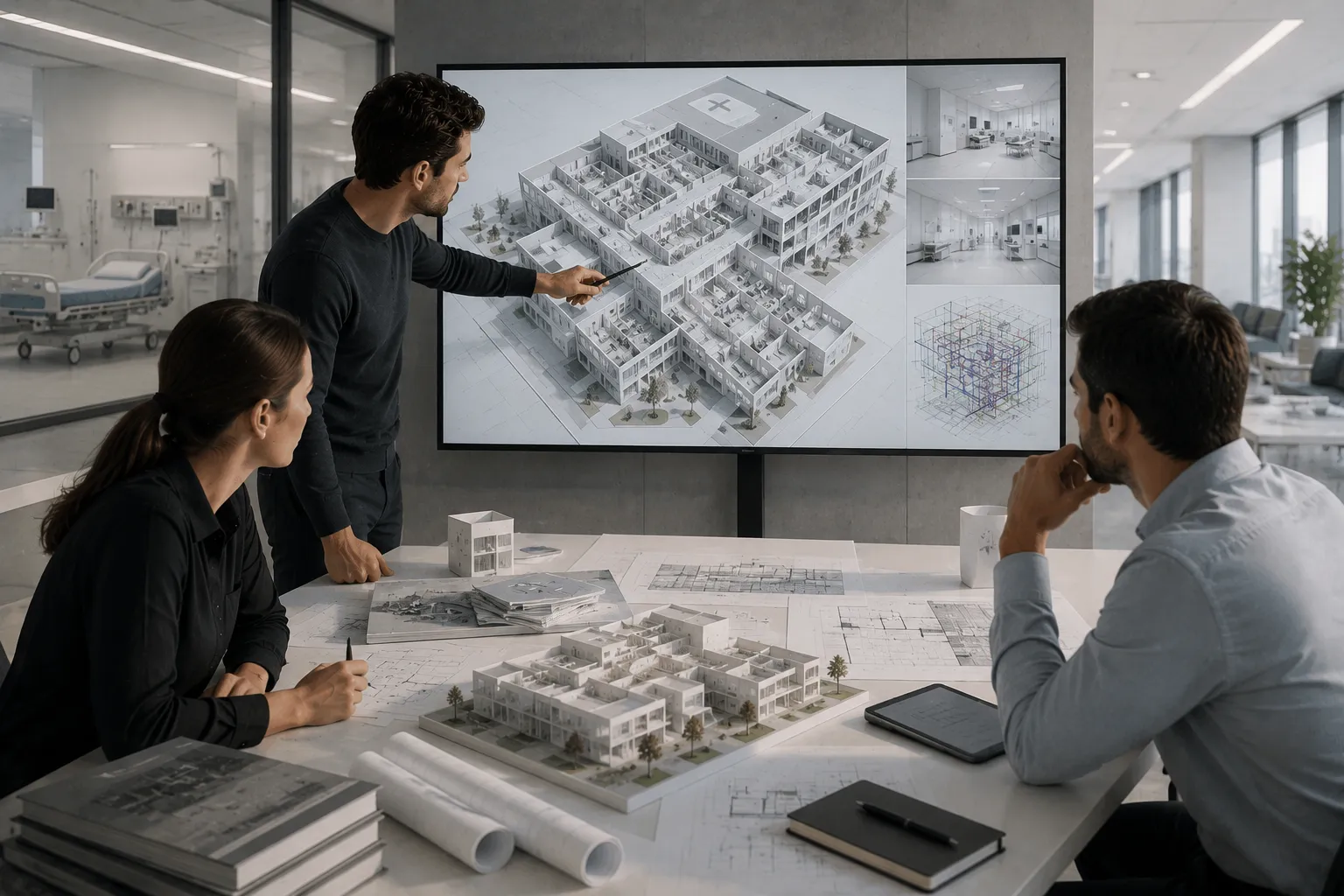
A medical center consultation room seems straightforward until you consider the 35+ compliance requirements governing that single space. Minimum room dimensions, door swing direction, hand basin location and type, surface material infection control properties, medical gas outlet positioning, nurse call system integration, accessible design provisions, acoustic privacy requirements, natural lighting standards, emergency power provisions, data and communication infrastructure, medical equipment clearances, and clinical workflow adjacencies. Each requirement derives from different regulatory sources spanning Australasian Health Facility Guidelines, National Safety and Quality Health Service Standards, Building Code provisions, Australian Standards, state health department policies, and infection prevention protocols.
For Design Principals pursuing healthcare work, compliance complexity extends across every space from treatment areas and operating theaters through patient rooms, diagnostic imaging, pathology laboratories, sterilizing services, pharmaceutical storage, and aged care resident rooms. Healthcare documentation errors don't just delay approvals; they can compromise patient safety, create infection control risks, and generate costly post-construction remediation when clinical staff identify operational deficiencies during commissioning.
This comprehensive guide provides Australian architects with detailed framework for healthcare facility documentation covering medical centers through hospitals and aged care. You'll learn facility-type specific requirements, Australian healthcare regulatory framework, infection prevention and control design standards, clinical planning and workflow documentation, healthcare BIM coordination requirements, medical equipment integration, and proven approaches from 80+ healthcare projects delivered across public and private health sectors since 2010.
Australian Healthcare Facility Types and Documentation Scope
Healthcare encompasses diverse facility types with distinct regulatory requirements and operational complexity.
Primary Care and Medical Centers
Primary care facilities ranging from single-practitioner consulting suites to multi-specialty medical centers form the foundation of Australian healthcare delivery. Typical medical center contains 8-15 consultation rooms sized 10-12 square meters minimum, treatment rooms for minor procedures requiring hand basins and medical gas, nurse stations and clinical support areas, waiting areas with separation for infectious patients where appropriate, reception and administrative areas, and accessible toilets including ambulant and standard accessible provisions.
Documentation scope addresses infection control requirements for clinical areas including impervious, seamless surfaces to floor-wall junctions, clinical hand basins separate from general hand washing, appropriate ventilation (minimum 6 air changes per hour for consultation rooms), medical waste management provisions, and pharmaceutical storage complying with TGA requirements for Schedule 4 and 8 medications where dispensed.
Primary care BIM models typically contain 3,000-8,000 elements with focus on clinical workflow efficiency, infection control compliance, and accessibility.
Hospitals and Day Surgery Centers
Hospitals and day surgery facilities represent most complex healthcare documentation encompassing operating theaters requiring stringent environmental controls (positive pressure, HEPA filtration, 25+ air changes per hour, humidity and temperature control), sterile services departments processing surgical instruments, recovery and post-anesthesia care units, diagnostic imaging (X-ray, CT, MRI with specific shielding and equipment requirements), pathology laboratories with specimen processing and storage, emergency departments with trauma capability, inpatient wards with ensuite patient rooms, intensive care and high-dependency units, and extensive support services (pharmacy, food services, engineering).
Operating theater documentation alone involves 200+ specific requirements covering room dimensions (minimum 36 square meters for general surgery, larger for specialty), services infrastructure (medical gases, electrical, data, nurse call), infection control (seamless floors extending 150mm up walls, laminar flow ceilings for orthopedic procedures), equipment (surgical lights, booms, tables with load calculations), and workflow (clean entry, dirty exit, instrument transfer, anesthesia zones).
Hospital BIM complexity reaches 50,000-200,000+ elements across multi-story buildings with intricate vertical services distribution and horizontal clinical workflow optimization.
Aged Care Residential Facilities
Aged care facilities blend residential character with healthcare capability. Typical 120-bed aged care facility includes resident rooms (minimum 16 square meters single, 25 square meters double with ensuite), dining and activity areas supporting social engagement, clinical areas including treatment rooms and medication preparation, dementia-specific secure areas where required, commercial kitchen and food services, laundry services, and administration and staff facilities.
Documentation addresses Aged Care Quality Standards, residential building classification (Class 9c), healthcare provisions where applicable (medication storage, clinical treatment), dementia design principles (wayfinding, secure boundaries, therapeutic gardens), and aging-in-place provisions supporting increased care levels.
Aged care facilities involve 15,000-35,000 BIM elements balancing residential amenity with clinical functionality.
Specialist Healthcare Facilities
Specialist facilities serve specific clinical functions including diagnostic imaging centers requiring radiation shielding design and ARPANSA compliance, pathology collection centers and laboratories, dialysis units with specialized medical equipment and services, mental health facilities with environmental safety provisions and ligature-free design, rehabilitation centers with therapy gyms and hydrotherapy, and oncology centers with radiation therapy bunkers and chemotherapy preparation.
Each specialist facility type has unique requirements beyond general healthcare standards requiring specific expertise and documentation approaches.
Healthcare Regulatory Framework and Standards
Australian healthcare facilities operate within comprehensive regulatory framework spanning national standards, state requirements, and clinical guidelines.
Australasian Health Facility Guidelines (AusHFG)
AusHFG represents primary reference for healthcare facility design in Australia and New Zealand. Maintained by Australian Health Facility Guidelines Advisory Committee, the guidelines provide detailed requirements across Part A: Policy and General Planning, Part B: Operational Planning, Part C: Design for Access, Entry, and Egress, Part D: Infection Control, and Part E: Building Services.
Critical AusHFG provisions include room data sheets specifying minimum areas, clearances, services, and equipment for hundreds of room types (consultation rooms, operating theaters, patient rooms, imaging suites), infection control requirements for ventilation, surfaces, and equipment, clinical workflow standards addressing patient flow and material movement, and services requirements for medical gases, electrical, water, and specialized systems.
AusHFG compliance is mandatory for public health facility funding in most Australian states and represents industry standard even for private healthcare facilities. Documentation must demonstrate compliance through room-by-room schedules extracted from BIM models, compliance matrices tracking requirements against design, annotated plans showing critical dimensions and clearances, and services coordination drawings confirming medical gas, electrical, and data provision.
National Safety and Quality Health Service Standards (NSQHS)
NSQHS Standards establish national framework for healthcare safety and quality. While primarily operational standards for healthcare providers, design implications include preventing healthcare-associated infections through appropriate environmental design, comprehensive care including facility design supporting care delivery, communicating for safety requiring appropriate clinical documentation systems, medication safety requiring secure pharmaceutical storage and preparation areas, and clinical governance requiring facilities enabling safe clinical practice.
Healthcare facility accreditation against NSQHS Standards requires appropriate environmental design supporting standard compliance. Documentation demonstrates design provisions supporting infection control practices, patient identification and matching processes, clinical handover communication, medication management safety, and clinical governance requirements.
Building Code and Accessibility Standards
Healthcare facilities have specific BCA provisions including Class 9a classification for healthcare buildings, Class 9c for aged care residential buildings, specific egress requirements for non-ambulatory patients, fire safety provisions for patient care areas, and infection control provisions influencing material selection.
Accessibility requirements extend beyond standard DDA compliance including accessible treatment rooms and consulting spaces, accessible patient rooms with ensuite facilities, accessible diagnostic imaging (wheelchair-accessible equipment where available), accessible dental chairs and examination tables where technically feasible, and wayfinding supporting cognitive accessibility.
AS 1428 suite of standards applies with healthcare-specific interpretations particularly regarding transfer spaces, maneuvering clearances in clinical areas, and accessible sanitary facilities serving patients with diverse mobility requirements.
Infection Prevention and Control Guidelines
Multiple infection control guideline documents inform healthcare design including Australian Guidelines for Prevention and Control of Infection in Healthcare, National Hand Hygiene Initiative guidelines influencing hand basin provision, Antimicrobial Resistance guidelines affecting material selection and cleaning protocols, and state health department specific infection control policies.
Design implications include ventilation requirements (air changes per hour varying by space type from 6 ACH in consultation rooms to 25+ ACH in operating theaters), pressure relationships (negative pressure for airborne infection isolation rooms, positive pressure for protective environments serving immunocompromised patients), surface materials (impervious, seamless, cleanable materials for clinical areas), hand hygiene facilities (clinical hand basins within 3 meters of patient care areas), and spatial separation (isolation room provisions, separate infectious patient waiting).
Medical Equipment and Safety Standards
Healthcare facilities must accommodate equipment complying with Therapeutic Goods Administration (TGA) medical device requirements, radiation safety requirements under Australian Radiation Protection and Nuclear Safety Agency (ARPANSA), pharmaceutical storage requirements from TGA for scheduled medications, medical gas systems complying with AS 2896, AS 4187, and AS 2030, and electrical safety requirements from AS/NZS 3003 electrical installations in healthcare facilities.
Documentation demonstrates compliance through equipment schedules, services coordination, and safety system integration.
Infection Prevention and Control Design Requirements
Infection prevention represents fundamental healthcare design driver affecting every clinical space.
Ventilation and Air Quality Requirements
Healthcare ventilation prevents airborne disease transmission and maintains environmental quality. AusHFG specifies minimum air change rates for clinical spaces including consultation and treatment rooms: 6 air changes per hour (ACH), operating theaters: 25 ACH minimum (higher for orthopedic and transplant procedures), airborne infection isolation rooms: 12 ACH with negative pressure, protective environment rooms for immunocompromised patients: 12 ACH with positive pressure, procedure rooms: 10-15 ACH depending on procedure type.
Pressure relationships prevent contaminant spread with isolation rooms maintaining negative pressure (-5 to -10 Pa) relative to corridors preventing airborne pathogen escape, clean areas maintaining positive pressure (+5 to +10 Pa) relative to corridors, and pressure cascades in operating theaters (positive theater, neutral anesthesia bay, negative dirty utility).
BIM coordination ensures services capacity, ductwork routing, pressure relationship achievement, and plant room sizing adequacy. Services engineers require detailed architectural spatial information early in design development enabling systems design meeting stringent healthcare ventilation requirements.
Surface Materials and Finishes
Clinical area finishes prevent microbial harboring and enable effective cleaning. Requirements include impervious sheet vinyl or equivalent flooring with heat-welded seams, minimum 100mm cove extending flooring up wall base, wall surfaces: vinyl, epoxy paint, or HPL sheet with sealed joints, ceiling systems: smooth, non-fibrous, cleanable (often vinyl-faced tiles), joinery: solid surface or HPL with sealed edges and minimal crevices, and minimal horizontal surfaces accumulating dust.
Material specifications document compliance with infection control requirements including manufacturer certifications for healthcare application, cleaning protocol compatibility, and antimicrobial properties where claimed.
Operating theaters and sterile processing areas have enhanced requirements including seamless floors extending 150mm up walls, sealed penetrations for services and equipment, stainless steel or solid surface benchtops, and smooth, cleanable ceiling systems without exposed services.
Hand Hygiene Compliance
Hand hygiene represents most effective infection prevention intervention. Design provisions include clinical hand basins within 3 meters of every patient care location, hands-free operation (elbow, knee, sensor, or foot-operated), separate from patient washing or general purpose basins, alcohol-based hand rub dispensers at room entry and patient bed locations, and clear sightlines enabling observation of hand hygiene compliance.
Hand basin provision often creates spatial challenges in small consultation rooms requiring early resolution during design development. BIM coordination prevents conflicts between hand basin locations, door swings, furniture layouts, and services rough-ins.
Clean and Dirty Separation
Healthcare facilities separate clean (sterile instruments, pharmaceuticals, food) from dirty (used instruments, contaminated materials, waste) preventing cross-contamination. Design provisions include separate clean and dirty utility rooms on inpatient units, dedicated dirty corridors for used instrument transport in surgical areas, separate clean and dirty receiving in sterile processing departments, pharmaceutical storage isolated from contaminated materials, and food services with separated clean and dirty workflows.
Workflow documentation through BIM demonstrates clean/dirty separation with color-coded flow diagrams, spatial relationship diagrams showing separation, and operational scenario testing validating workflow integrity.
Clinical Planning and Operational Workflow
Healthcare functionality depends on optimized clinical workflows documented through planning studies informing architectural design.
Patient Flow and Separation
Efficient, safe patient flow requires careful planning separating ambulatory from non-ambulatory patients, infectious from non-infectious patients, inpatient from outpatient movements, emergency from elective patient access, and public from staff circulation where appropriate.
Emergency departments exemplify complex patient flow with separate entrances for walk-in and ambulance patients, rapid triage and streaming to treatment areas, isolation rooms for infectious presentations, separate pediatric areas, mental health assessment rooms with environmental safety, and direct access to imaging and pathology without crossing public areas.
BIM documentation demonstrates patient flow through annotated plans showing primary and secondary patient routes, color-coded flow diagrams distinguishing patient types, operational simulation identifying bottlenecks or conflicts, and accessibility compliance throughout patient journey.
Staff Workflow and Support
Healthcare delivery requires efficient staff movement and appropriate support spaces including direct access from staff areas to patient care zones, adequate staff facilities (meeting rooms, tea rooms, change rooms, offices), equipment and supply storage minimizing staff travel, and medication preparation areas visible to but separate from patient areas.
Nursing stations position requires visibility to patient rooms (especially in intensive care and high-dependency units), proximity to medication preparation and storage, adjacency to staff support facilities, and acoustic separation from patient areas for confidential discussions.
Material Transport and Supply Chain
Healthcare facilities move substantial materials including pharmaceuticals, medical consumables, food, clean linen, used linen, and waste (general, clinical, sharps, pharmaceutical). Efficient supply chains require dedicated clean supply storage areas, material transport routes (separate from public circulation where possible), vertical transport adequate for bed and equipment movement, receiving and dispatch facilities, and soiled material holding areas with appropriate ventilation.
Large hospitals incorporate dedicated goods lifts, service corridors, and pneumatic tube systems for pathology specimen and document transport. BIM coordination ensures adequate vertical penetrations, corridor widths accommodating transport, and loading dock sizing for delivery vehicles and waste collection.
Emergency Response and Code Blue
Healthcare facilities must accommodate medical emergency response including clear, wide corridors enabling emergency equipment access (crash trolleys, portable X-ray, mobile beds), adequate space at patient locations for resuscitation teams (typically 6-8 clinical staff), emergency power for life-support equipment, and rapid access to emergency equipment storage.
Documentation demonstrates emergency response capability through clearance verification around patient beds, corridor width compliance (minimum 2.4 meters for bed passing), equipment storage proximity mapping, and emergency power provisions.
BIM Requirements for Healthcare Projects
Healthcare BIM documentation serves clinical planning, infection control compliance, medical equipment coordination, and facilities management.
Information Requirements and LOD
Healthcare projects demand high information fidelity supporting clinical review, compliance verification, and equipment coordination. Level of Development requirements typically include design development (clinical review and health department approval): LOD 300 with room layouts, equipment locations, and service provision, construction documentation (DA, CC, tender): LOD 350-400 with construction detail, and as-built documentation (handover to health facility): LOD 400-500 including as-built geometry, equipment data, and maintenance information.
State health departments increasingly specify BIM deliverables for public healthcare projects including coordinated architectural, structural, and services models, COBie data export for asset management systems, specific naming conventions and data standards, and integration with health department BIM libraries.
Model Organization for Clinical Complexity
Healthcare facility complexity requires disciplined model organization with spatial hierarchy reflecting clinical departments and precincts (emergency, surgery, imaging, pathology, inpatient units), clean/dirty zoning visible through model organization or color coding, infection control zones (isolation, protective environment, standard precautions), public/staff/patient separation, and emergency egress routes.
Workset organization enables discipline coordination including architectural shell and core, architectural fit-out (clinical joinery, equipment), medical equipment (often separate worksets by type), MEP systems with healthcare-specific subdivisions (medical gases, emergency power, nurse call), and temporary works for staged construction in occupied facilities.
Clinical Equipment Coordination
Medical equipment drives spatial design and must integrate in BIM from design development forward. Equipment modeling includes fixed equipment (dental chairs, examination tables, surgical tables with C-arm clearances), mobile equipment requiring clearance (portable X-ray, ultrasound, patient beds), suspended equipment (surgical lights, medical booms, ceiling-mounted monitors), and wall-mounted equipment (examination lights, monitors, gas outlets).
Equipment coordination prevents common issues including imaging equipment installation conflicts (MRI magnets requiring access before wall completion, CT scanners exceeding floor load capacity, radiation shielding conflicting with structural systems), surgical equipment clearances (surgical lights and booms conflicting with ceiling systems, operating table positioning relative to gas outlets and electrical provisions), and patient handling equipment (ceiling hoist tracks coordinating with structure and services, height clearances for bed positioning equipment).
Manufacturers' BIM content varies widely in quality. Healthcare BIM requires generic equipment families for design coordination with accurate spatial envelopes, manufacturer-specific models for constructed elements (integrated sinks, surgical booms), and equipment specifications linking to TGA compliance and maintenance data.
Services Coordination and Medical Gases
Healthcare services complexity exceeds typical commercial buildings requiring extensive coordination. Medical gas systems alone involve oxygen, medical air, vacuum, nitrous oxide, carbon dioxide, nitrogen, AGSS (anesthetic gas scavenging system), each requiring dedicated outlets, zone valves, alarm panels, and backup provisions. BIM coordination prevents service conflicts and demonstrates compliance with AS 2896 medical gas requirements.
Electrical services include normal power, essential power (backed by generator), uninterruptible power supply (UPS) for critical loads, isolated power supply (for patient safety in specific locations), nurse call systems, data and communications, and audiovisual systems in operating theaters and procedural areas.
Coordinated services models identify conflicts early when resolution is inexpensive rather than during construction requiring costly rework. Healthcare services coordination represents substantial BIM value through clash detection preventing installation conflicts, coordination drawings showing resolved services layouts, system capacity verification ensuring adequate infrastructure, and as-built documentation supporting maintenance and future modifications.
Medical Equipment and Services Coordination
Healthcare functionality depends on seamless integration between architectural design, building services, and medical equipment.
Medical Gas Systems Integration
Medical gas systems provide life-support and treatment capability requiring careful coordination. AS 2896 mandates specific requirements including outlet heights (1,200-1,400mm above floor in patient care areas, different heights for operating theaters), minimum outlet quantities per location (inpatient rooms: oxygen and vacuum minimum, theaters: oxygen, vacuum, medical air, AGSS minimum), zone valve accessibility for isolation during maintenance, manifold and plant room sizing and location, and alarm panel visibility to staff.
BIM coordination demonstrates outlet locations coordinated with equipment layouts and accessible to clinical staff, vertical distribution routing coordinated with structure and other services, plant room adequacy for gas storage, manifolds, and compressors, and compliance with separation requirements (oxygen sources separated from fuel sources).
Diagnostic Imaging Integration
Imaging equipment introduces unique architectural requirements. X-ray and fluoroscopy require lead-lined walls, floors, and ceilings (typically 2-4mm lead equivalent, designed by radiation physicist), operator control rooms with lead glass viewing windows, and electrical provisions for high-power equipment.
CT scanners require substantial floor load capacity (equipment weight plus patient table), adequate access for installation (scanners delivered as single large unit), cooling provisions for heat generation, and lead shielding (lighter than X-ray typically 1-2mm equivalent).
MRI scanners require non-ferrous construction within magnetic field zone, RF (radio frequency) shielding creating Faraday cage, substantial equipment mass (up to 12,000kg for 3T magnets), installation access before walls completed, cooling provisions, and quench vent to exterior.
BIM coordination for imaging integrates structural analysis for equipment loads, access sequence planning for installation, shielding coordination with structure and services, and electrical and cooling infrastructure adequacy verification.
Pathology Laboratory Equipment
Pathology laboratories contain specialized equipment including automated specimen processors, refrigerated storage units, chemical storage requiring ventilation, microscopy workstations, and specimen preparation areas. Equipment coordination addresses chemical fume hood extraction coordinated with architectural and services, equipment electrical requirements (often substantial), bench layouts optimized for workflow and access, and refrigeration heat rejection coordinated with HVAC systems.
Surgical Equipment and Booms
Operating theaters integrate extensive equipment including surgical lights (ceiling mounted, requiring structure coordination), medical booms supporting equipment and services (gas, electrical, data), surgical tables with imaging equipment clearance requirements, anesthesia machines and monitoring equipment, scrub sinks with hands-free operation, and equipment storage within theater but outside sterile field.
Equipment coordination complexity requires dedicated coordination between medical equipment suppliers, services engineers, and architects. BIM coordination prevents ceiling service conflicts, demonstrates adequate clearances, and verifies power and gas provisions.
Stakeholder Engagement and Clinical User Input
Healthcare projects require extensive clinical user engagement informing functional design and operational efficiency.
Health Department and Clinical Governance
Public healthcare projects involve health department facilities teams overseeing capital works. Engagement includes design reviews at project gateways (concept, schematic, detailed design), compliance verification against AusHFG and departmental standards, clinical service planning alignment, and budget and program oversight.
Private healthcare projects involve medical director or clinical governance committees performing similar review functions ensuring clinical appropriateness and operational efficiency.
Clinical Staff Workshops
Clinical users provide essential operational knowledge through structured workshops exploring clinical workflows and patient journeys, equipment requirements and storage needs, infection control practices and preferences, staff support facility adequacy, and future flexibility and growth requirements.
Workshop formats include current state mapping documenting existing workflows and pain points, future state visioning exploring optimal workflows in new facility, scenario testing using BIM visualizations validating layouts, and equipment reviews confirming provision adequacy.
Documentation includes workshop reports capturing requirements and decisions, requirement registers tracking clinical inputs, design response documentation explaining how feedback informed design, and sign-off documentation confirming clinical user acceptance.
Infection Control Practitioner Input
Hospital infection control practitioners review designs ensuring infection prevention compliance. Review addresses ventilation and pressure relationships, surface material selections, hand hygiene facility provision, clean/dirty separation, and isolation room adequacy.
Infection control review often identifies operational considerations not evident in standards including equipment cleaning and storage locations, contaminated material handling workflows, infectious patient management procedures, and environmental cleaning access and methodology.
Medical Equipment Planning Consultant
Complex healthcare facilities engage medical equipment planning consultants coordinating equipment procurement with facility design. Medical planner responsibilities include comprehensive equipment schedules with specifications, equipment layouts coordinated with architectural design, services requirements for equipment (electrical, medical gases, data), budget cost estimation for equipment procurement, and equipment commissioning coordination.
Medical planner input informs BIM through equipment models and specifications, services load requirements, installation sequence requirements, and maintenance access provisions.
Healthcare-Specific Compliance Documentation
Healthcare compliance documentation extends beyond standard DA and CC submissions.
AusHFG Compliance Matrix
Health department approvals require comprehensive AusHFG compliance documentation. Compliance matrix lists every applicable AusHFG requirement (often 500+ individual provisions for complex facilities), design compliance response for each requirement, and drawing/document reference demonstrating compliance.
BIM models support compliance matrices through room schedules extracted from model confirming areas, equipment schedules verifying provision, and annotated plans highlighting compliance provisions.
Infection Control Compliance Report
Infection control compliance reporting addresses ventilation design including ACH rates for all clinical spaces, pressure relationships and airborne infection isolation, surface materials in clinical areas, hand hygiene facility locations, and clean/dirty separation provisions.
Documentation includes services design calculations, material specifications, and annotated plans showing infection control provisions.
Medical Equipment Coordination Drawings
Equipment coordination documentation demonstrates integration between medical equipment, architecture, and building services including equipment layouts with clearances, medical gas outlet locations and types, electrical provisions (normal, essential, UPS power), data and communications provisions, and structural load verification for heavy equipment.
Operational Scenario Documentation
Complex healthcare facilities document operational scenarios testing functional design including emergency patient admission workflows, surgical procedure workflows from patient preparation through recovery, specimen transport from collection through pathology processing, pharmaceutical dispensing and administration workflows, and infection control scenarios (isolation patient admission, outbreak response).
Scenario documentation uses BIM visualizations, annotated plans showing movement, and narrative descriptions validating operational adequacy.
FAQ: Healthcare Facility BIM Documentation
What makes healthcare documentation more complex than other commercial projects?
Healthcare combines functional complexity (diverse clinical spaces with distinct requirements), stringent infection control standards (ventilation, pressure, materials, workflows), extensive medical equipment coordination (imaging, surgical, diagnostic, life support), multi-layered regulatory compliance (AusHFG, NSQHS, BCA, AS standards, TGA, ARPANSA), clinical workflow optimization requiring operational expertise, and operational risk where documentation errors create patient safety concerns. Typical medical center involves 15-25 distinct room types each with specific requirements, compared to 3-8 in commercial office. Hospitals involve 100+ room types with extensive interdependencies. Regulatory framework spans building codes, health facility guidelines, infection control protocols, medical equipment standards, radiation safety, pharmaceutical regulations, and clinical governance requirements creating unprecedented compliance complexity requiring healthcare sector expertise.
How do infection control requirements influence BIM coordination?
Infection control drives spatial planning, material selection, and services design requiring early BIM integration. Ventilation requirements (6-25+ ACH depending on space type, pressure relationships, filtration) require services coordination from design development ensuring adequate plant capacity, ductwork routing through constrained ceiling spaces, and pressure relationship achievement through air balance. Surface materials (impervious, seamless finishes) affect architectural detailing with sealed floor-wall junctions, minimal horizontal surfaces, and cleanable finishes modeled accurately. Clean/dirty separation influences spatial organization visible in BIM through zoning, color coding, and workflow diagrams. Hand hygiene facility locations (clinical basins within 3 meters of patient care) require coordination with door swings, furniture layouts, and services rough-ins. BIM enables infection control compliance verification through 3D visualization showing pressure relationships and workflows, material schedules demonstrating compliant specifications, and coordination preventing installation conflicts affecting infection control performance.
What BIM deliverables do health departments typically require?
Health department BIM requirements vary by state and project scale but increasingly include coordinated models at LOD 350-400 (design documentation) and LOD 400-500 (as-built), AusHFG compliance schedules extracted from BIM (room areas, equipment provision, services), COBie data export for asset management system integration, medical equipment registers with specifications and maintenance data, infection control documentation including ventilation design parameters, 3D visualizations supporting clinical review and community consultation, and native BIM files plus IFC exports. Some states specify proprietary standards or templates. Queensland Health has detailed BIM requirements. NSW Health increasingly requires BIM deliverables. Clarify specific requirements during project inception as retroactive BIM preparation is substantially more expensive than maintaining coordination throughout design and construction. Private healthcare organizations have varying requirements from minimal to sophisticated depending on facilities management capabilities.
How do we coordinate medical equipment when manufacturers don't provide BIM content?
Medical equipment coordination without manufacturer BIM content requires systematic approach. Create generic equipment families with accurate spatial envelopes during design development enabling clearance verification and services coordination. Dimensions from manufacturer specification sheets typically provide adequate information. Model fixed equipment accurately (dental chairs, examination tables, surgical tables with C-arm swing clearances, ceiling-mounted surgical lights and booms). Model mobile equipment as space reservations (portable X-ray, ultrasound machines, patient beds at critical locations). Coordinate with medical equipment planning consultant who maintains comprehensive equipment schedules and specifications. Request manufacturer BIM content when available but expect variation in quality requiring verification. For critical equipment (MRI, CT, linear accelerators), engage manufacturers early obtaining CAD or native equipment models and structural/services requirements. Document equipment requirements through schedules, equipment layouts, and services coordination drawings extracted from BIM even when equipment itself is generic placeholder.
What role does clinical user engagement play in BIM documentation?
Clinical users provide operational knowledge essential to functional design that architects and engineers cannot intuit. Engagement through workshops informs spatial layouts and adjacencies reflecting actual workflows rather than theoretical assumptions, equipment selection and specifications matching clinical practice patterns, infection control practices and preferences varying by specialty and facility, storage adequacy for supplies, equipment, and medications based on utilization patterns, and future flexibility requirements anticipating clinical service evolution. BIM supports clinical engagement through 3D visualizations helping non-technical users understand spatial proposals, virtual reality walkthroughs enabling scenario testing and workflow validation, iterative design updates incorporating clinical feedback rapidly, and equipment layouts demonstrating provision adequacy. Clinical user buy-in reduces post-construction variations and rework when staff identify operational deficiencies only after building completion. Systematic clinical engagement incorporating feedback into BIM documentation substantially improves healthcare facility functionality and user satisfaction while reducing risk of expensive post-occupancy modifications.
Delivering Safe, Compliant Healthcare Environments
Healthcare facility documentation demands specialized expertise spanning infection prevention, clinical workflow, medical equipment integration, and multi-layered regulatory compliance. From medical centers through hospitals and aged care facilities, Australian healthcare facilities operate within comprehensive framework combining Australasian Health Facility Guidelines, National Safety and Quality Health Service Standards, infection control protocols, Building Code healthcare provisions, medical equipment standards, and radiation safety requirements while satisfying health departments, clinical users, planning authorities, and building certifiers.
BIM documentation supports healthcare complexity through coordinated multi-discipline models managing clinical workflow optimization, infection control compliance demonstration, medical equipment coordination with architecture and services, detailed compliance schedules extracted from model data, and as-built documentation supporting facilities management and future modifications.
Success in healthcare sector requires understanding facility-type variations from primary care through acute hospitals, regulatory framework spanning AusHFG through infection control guidelines, clinical planning processes engaging healthcare providers, medical equipment coordination integrating manufacturers' requirements, and compliance documentation demonstrating regulatory requirement satisfaction.
Obelisk has delivered BIM documentation for 80+ healthcare facilities across Australia spanning medical centers, day surgery facilities, imaging centers, pathology laboratories, aged care facilities, and hospital departments. Our healthcare sector expertise encompasses AusHFG compliance documentation and room data sheet requirements, infection prevention and control design standards and verification, clinical workflow coordination with healthcare planning consultants, medical equipment integration with manufacturers and suppliers, and as-built BIM delivery supporting health department asset management.
Healthcare Facility BIM Documentation Services
Obelisk provides specialist BIM documentation for healthcare facilities meeting Australian standards and clinical requirements.
✓ Healthcare Sector Expertise: 80+ medical centers, hospitals, aged care facilities
✓ AusHFG Compliance: Comprehensive compliance documentation and verification
✓ Infection Control: Design documentation meeting prevention standards
✓ Clinical Coordination: Medical equipment and workflow integration
✓ Medical Equipment: Coordination with imaging, surgical, diagnostic systems
✓ Asset Management: As-built documentation supporting facilities management
We help Australian architects deliver compliant healthcare facilities serving patient care.
Discuss Your Healthcare Project: team@obelisk.au
Specialist healthcare facility BIM documentation for Australian medical buildings.
TABLE OF CONTENTS






















.png)
.png)
.webp)